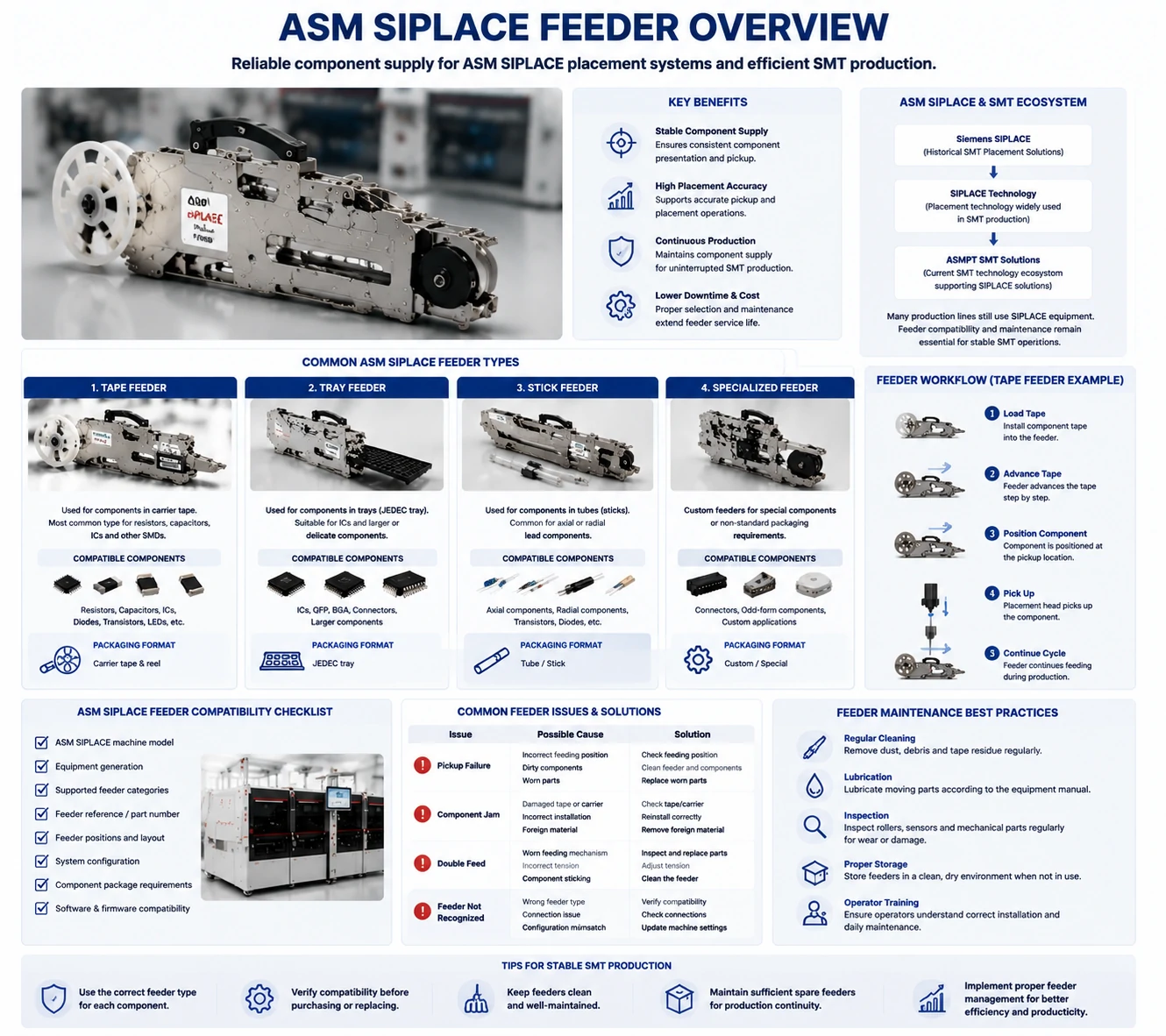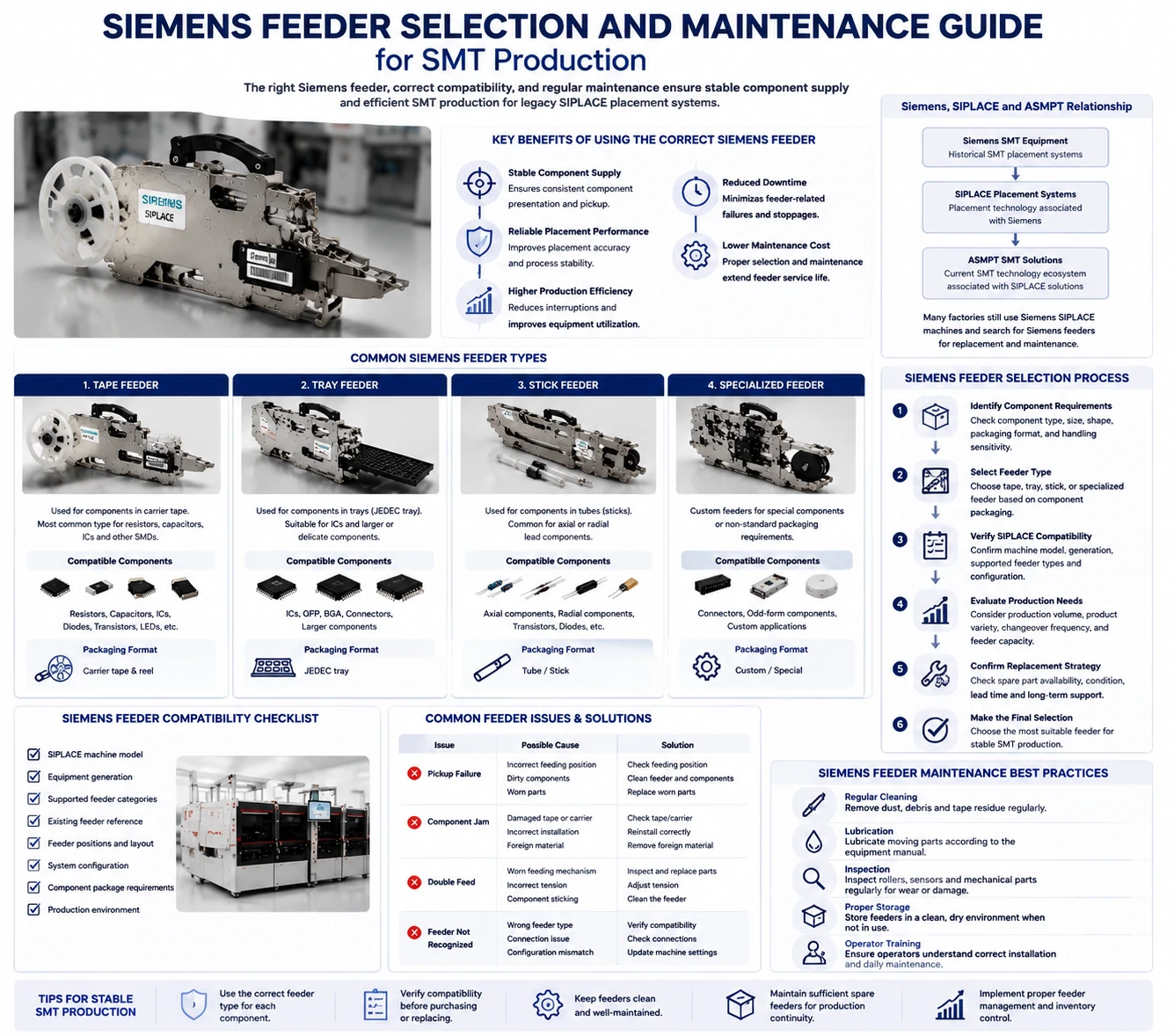

In SMT manufacturing, reliable component feeding is essential for stable PCB assembly production. The Siemens Feeder is a machine component used with Siemens SMT placement equipment to supply electronic components to placement heads during automated assembly processes.
Many users continue searching for Siemens Feeder because Siemens was historically one of the major SMT equipment brands, and many production lines still operate Siemens SIPLACE placement systems. Today, SIPLACE technology is part of the ASMPT SMT Solutions ecosystem, but Siemens terminology remains widely used when engineers search for feeders, replacement components, and maintenance information.
Understanding Siemens Feeder technology helps SMT engineers, equipment technicians, and production teams manage legacy placement systems, evaluate feeder compatibility, and maintain stable PCB assembly workflows.
This guide explains Siemens Feeder technology, its relationship with SIPLACE placement systems, feeder operation principles, common feeder categories, compatibility considerations, replacement planning, troubleshooting, and maintenance practices.
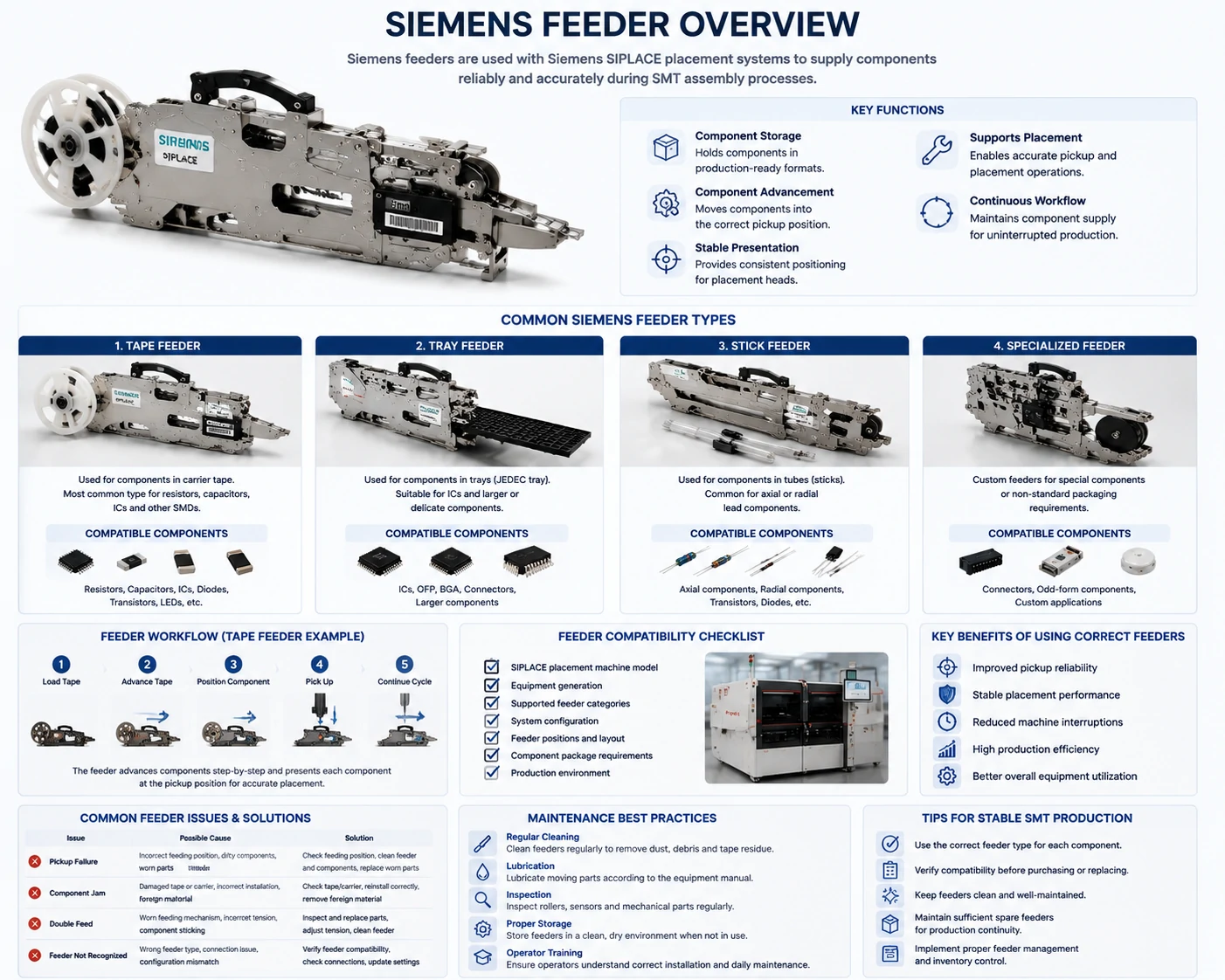
What Is a Siemens Feeder?
A Siemens Feeder is an SMT component supply device used with Siemens SIPLACE placement systems to provide electronic components during automated PCB assembly processes.
The feeder prepares components from their storage format and presents them at a controlled pickup position so that placement heads can collect and place components accurately onto printed circuit boards.
In a typical SMT production workflow, the feeder connects three important elements:
Component storage and preparation
Automated component feeding
Placement machine operation
A stable feeder system is important because placement machines depend on accurate component presentation to maintain production efficiency and assembly quality.
The Role of Feeders in SMT Assembly
Feeders are essential components in SMT production because placement machines require a continuous and accurate supply of electronic components.
The main functions of Siemens Feeders include:
Holding components in production-ready packaging formats
Advancing components into the pickup position
Supporting automated placement operations
Maintaining consistent component presentation
Supporting continuous SMT production workflows
In PCB assembly production, feeder performance directly affects how efficiently placement machines can operate.
Why Siemens SIPLACE Machines Require Reliable Feeders
Siemens SIPLACE placement machines depend on accurate component feeding to maintain stable SMT production workflows.
A reliable feeder helps support:
Consistent component pickup
Stable placement operations
Reduced production interruptions
Improved assembly process control
Better equipment utilization
Because SMT production often involves thousands of component placement operations, feeder condition and compatibility are important factors in maintaining production stability.
Siemens, SIPLACE, and ASMPT Relationship
Understanding the relationship between Siemens Feeder and SIPLACE equipment is important for engineers maintaining legacy SMT production systems.
Siemens SMT Equipment Background
Siemens was historically a major supplier of SMT placement equipment, and SIPLACE became a well-known name associated with Siemens placement systems.
Many SMT factories continue operating legacy Siemens SIPLACE machines, which creates ongoing demand for feeder information, replacement support, and compatibility verification.
From Siemens SIPLACE to ASMPT SMT Solutions
SIPLACE technology is now associated with ASMPT SMT Solutions. However, many engineers still use Siemens terminology when searching for:
Siemens feeders
SIPLACE feeders
Legacy SMT replacement parts
Maintenance information
Because legacy equipment may remain in production for many years, accurate understanding of Siemens and SIPLACE terminology helps engineers locate suitable technical information.
Why Siemens Feeder Compatibility Matters
Siemens Feeder compatibility should always be verified according to the specific placement machine system.
Important compatibility factors include:
Placement machine model
Equipment generation
Feeder type
System configuration
Production requirements
Not all Siemens feeders are compatible with every SIPLACE system. Equipment documentation and configuration verification should be reviewed before replacement or installation.
How Siemens Feeder Works
A Siemens Feeder works by preparing and presenting components so that a placement machine can accurately pick them up during PCB assembly.
The general feeder workflow includes:
Loading components into the feeder
Advancing components through the feeding mechanism
Positioning components at the pickup location
Allowing the placement head to collect components
Continuing the feeding cycle during production
Component Tape Feeding Process
Tape feeding is one of the most common methods used in SMT production because many electronic components are supplied in carrier tape formats.
The tape feeding process generally includes:
Installing component tape into the feeder
Advancing the tape through the feeding mechanism
Presenting components at the pickup position
Allowing automated component collection
Stable tape movement is important because incorrect component presentation may affect pickup reliability and placement quality.
Component Positioning Before Pickup
Before a placement head collects a component, the feeder must present it in a controlled and repeatable position.
Accurate component positioning supports:
Reliable pickup operations
Consistent placement results
Reduced feeding-related errors
Improved production stability
Feeder condition, mechanical accuracy, correct setup, and component loading all influence component presentation quality.
Communication Between Feeder and Placement Machine
Modern SMT production requires coordination between feeders and placement systems. The placement machine needs to recognize and manage feeder information during operation.
This interaction may include:
Feeder identification
Machine configuration information
Production synchronization
Operational status monitoring
Proper feeder and machine coordination helps maintain an efficient SMT workflow and reduces production interruptions.
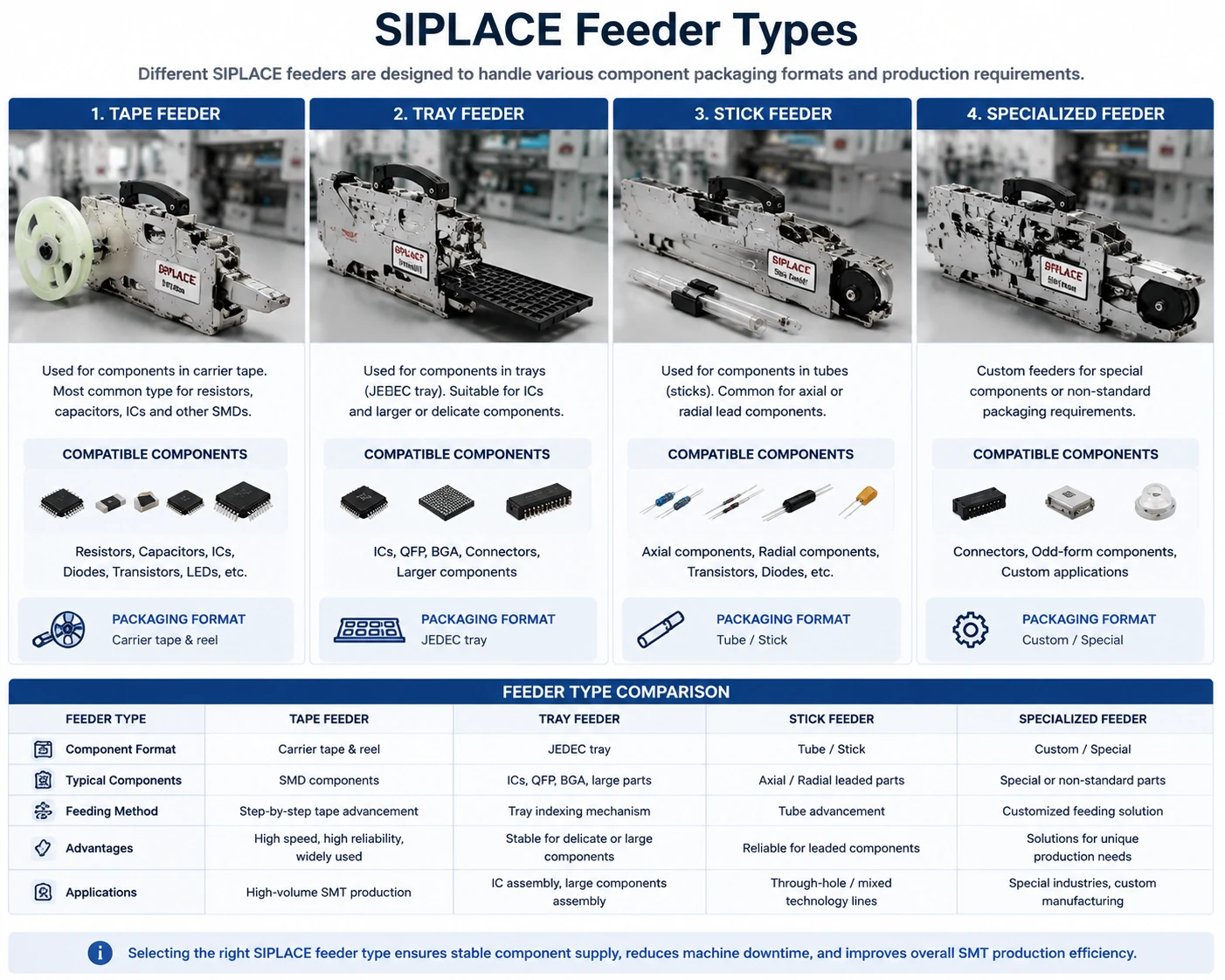
Common Siemens Feeder Types
Different electronic components require different feeding methods. Siemens Feeder selection depends on component packaging formats, production requirements, placement machine configuration, and equipment generation.
Selecting the correct feeder category helps maintain stable component supply and supports reliable SMT placement operations.
| Feeder Type | Typical Application | Selection Consideration |
|---|---|---|
| Tape Feeder | Components supplied in carrier tape formats for automated placement. | Tape format, component size, feeding accuracy, machine compatibility. |
| Tray Feeder | Larger components or special packages requiring tray handling. | Package structure, component protection, positioning requirements. |
| Stick Feeder | Components supplied in tube or stick packaging formats. | Component format, feeding stability, production requirements. |
| Specialized Feeder | Components requiring specific handling methods. | Component characteristics, flexibility, equipment configuration. |
Tape Feeders
Tape feeders are widely used in SMT production because many electronic components are supplied in carrier tape formats.
They support applications requiring:
Continuous component supply
Automated pickup operations
High-volume PCB assembly
Stable placement workflows
When selecting a tape feeder, engineers should consider:
Component tape format
Component dimensions
Feeding consistency requirements
Compatibility with Siemens SIPLACE equipment
Tray Feeders
Tray feeders are designed for components that require tray-based handling instead of tape feeding.
They are commonly considered for:
Larger semiconductor packages
Special component formats
Components requiring individual positioning
Devices with specific handling requirements
Tray feeder selection depends on package characteristics, machine configuration, and production requirements.
Stick Feeders
Stick feeders support components supplied in tubes or stick packaging formats.
They provide an alternative feeding method when components cannot be supplied through standard tape formats.
Important considerations include:
Component packaging style
Feeding stability
Component orientation requirements
Production workflow needs
Specialized Component Feeders
Some SMT production environments require specialized feeders for unique component formats or production requirements.
These feeders are selected based on:
Component characteristics
Special handling requirements
Production flexibility
Equipment configuration
Siemens Feeder Compatibility Guide
Compatibility verification is one of the most important steps when selecting or replacing Siemens Feeders, especially for legacy SIPLACE production systems.
Because Siemens SIPLACE equipment has different generations and configurations, feeder compatibility should always be confirmed according to the specific machine system.
Factors Affecting Siemens Feeder Compatibility
Engineers should evaluate:
Placement machine model
Equipment generation
Feeder category
System configuration
Production requirements
A feeder that works with one SIPLACE system may not necessarily be suitable for another machine configuration.
Legacy SIPLACE Equipment Considerations
Many factories continue operating legacy Siemens SIPLACE production lines. For these systems, feeder selection often requires additional verification because equipment may have different generations, configurations, and replacement requirements.
When maintaining legacy systems, engineers should consider:
Existing feeder references
Machine documentation
Current production setup
Replacement availability
Long-term maintenance planning
Accurate verification helps reduce risks associated with incorrect feeder replacement.
Applications of Siemens Feeders in SMT Manufacturing
Siemens Feeders are used in SMT production environments where automated component placement is required, especially in Siemens SIPLACE equipment installations.
PCB Assembly Production
In PCB assembly lines, Siemens Feeders provide the component supply required for automated placement machines.
The feeder supports:
Component preparation
Placement workflow continuity
Automated production processes
Stable SMT operation
High-Speed Component Placement
High-speed SMT production requires reliable component feeding because placement machines depend on consistent component presentation.
Feeder performance influences:
Pickup consistency
Production stability
Workflow efficiency
Equipment utilization
Proper feeder management helps manufacturers maintain continuous production processes.
Legacy Siemens SIPLACE Production Lines
Many legacy Siemens SIPLACE production lines remain in operation, creating continued demand for feeder information, replacement support, and compatibility guidance.
For these systems, engineers often need to evaluate:
Existing machine configuration
Feeder generation
Replacement options
Compatibility requirements
Maintenance history
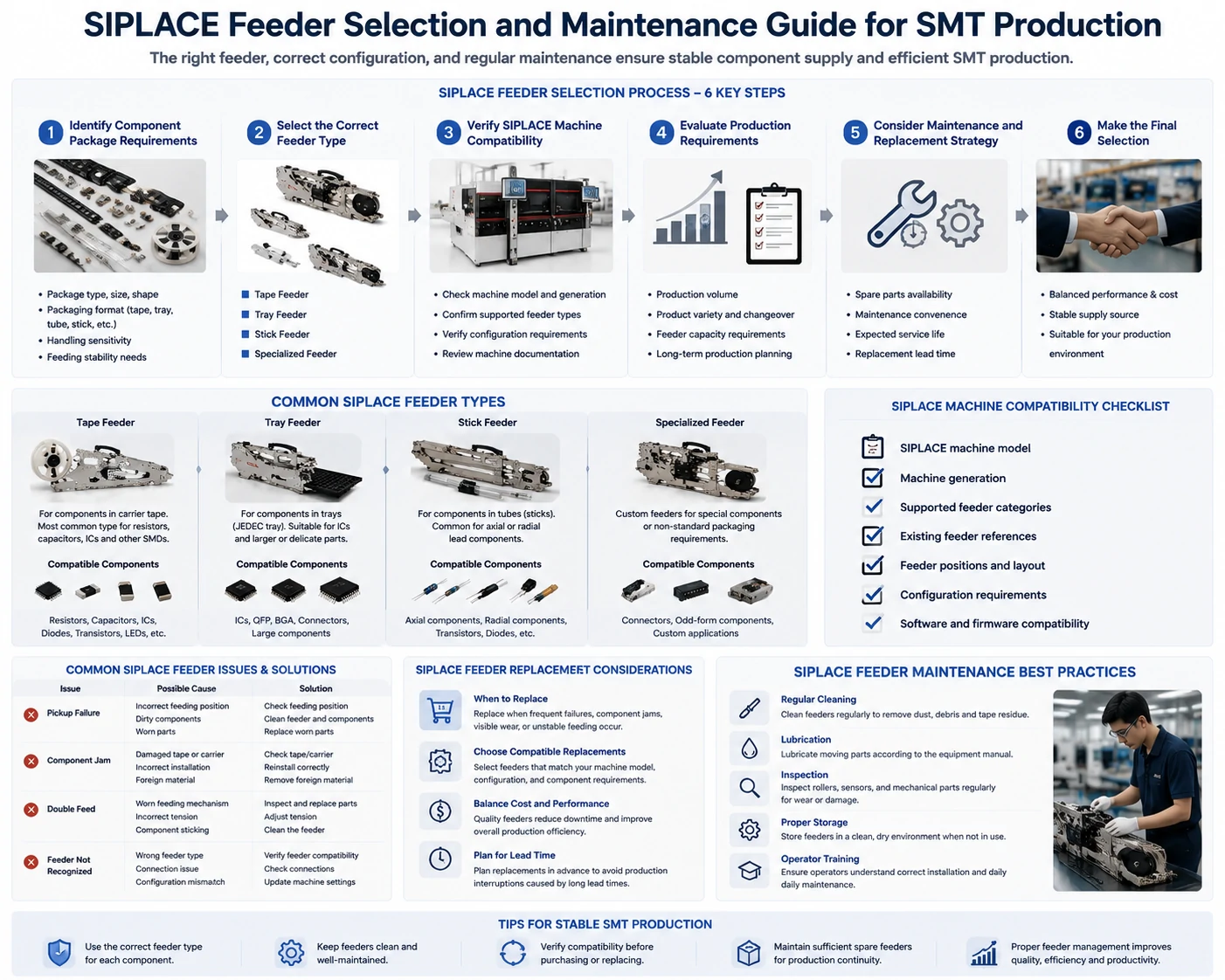
Siemens Feeder Selection Process
Selecting the correct Siemens Feeder requires matching component requirements, machine compatibility, production conditions, and maintenance considerations.
Step 1: Identify Component Requirements
The first step is understanding the components being assembled.
Engineers should evaluate:
Component packaging format
Component size
Handling requirements
Placement process conditions
Step 2: Select Suitable Feeder Type
After identifying component requirements, the appropriate feeder category should be selected.
The basic relationship can be summarized as:
Tape components → Tape feeder
Tray components → Tray feeder
Tube components → Stick feeder
Special formats → Specialized feeder
Step 3: Verify SIPLACE Compatibility
The selected feeder should be verified against the target Siemens SIPLACE placement system.
Verification should include:
Machine model
Equipment generation
Feeder configuration
Production requirements
Siemens Feeder Replacement Considerations
Replacing a Siemens Feeder requires careful identification and compatibility verification. Selecting a replacement feeder without confirming equipment requirements may result in installation problems, feeding issues, or production interruptions.
A proper replacement process should include:
Feeder identification
Machine compatibility verification
Component requirement review
Technical documentation checking
Maintenance history evaluation
Siemens Feeder Replacement Checklist
Before replacing a Siemens Feeder, engineers should confirm:
Existing feeder information:Verify current feeder references, labels, and equipment records.
Machine compatibility:Confirm that the replacement feeder matches the Siemens SIPLACE system configuration.
Feeder category:Ensure the replacement feeder supports the required component packaging format.
Production requirements:Check that the replacement solution fits the current SMT workflow.
Maintenance history:Review previous feeder usage and service records.
Part Number and Documentation Verification
Accurate feeder identification is important when managing legacy Siemens SMT equipment.
Engineers should review:
Feeder references
Equipment documentation
Machine configuration information
Maintenance records
Supplier information
Documentation-based verification helps reduce the risk of selecting unsuitable replacement components.
Siemens Feeder Maintenance and Troubleshooting
Regular maintenance helps maintain Siemens Feeder performance and reduce SMT production problems.
Because feeders directly affect component supply and pickup operations, proper maintenance is important for stable PCB assembly performance.
Common Siemens Feeder Problems
Feeder-related issues may affect SMT production when components are not presented correctly to the placement machine.
Common problems may include:
Feeding inconsistency:Components are not advanced smoothly through the feeder mechanism.
Pickup failure:The placement head cannot collect components correctly.
Component presentation problems:Components are not positioned accurately for pickup.
Setup problems:Feeder settings do not match production requirements.
Mechanical issues:Wear or contamination affects feeder operation.
Siemens Feeder Troubleshooting Checklist
A structured troubleshooting process helps technicians identify feeder-related problems more efficiently.
Engineers can check:
Component loading:Confirm components are correctly loaded into the feeder.
Feeder installation:Verify that the feeder is properly installed on the placement machine.
Feeding mechanism:Check whether components advance correctly.
Pickup position:Confirm that components are presented at the correct location.
Machine configuration:Verify feeder settings match the production program.
This process helps reduce unnecessary replacement decisions and supports faster SMT production recovery.
Cleaning and Inspection
Routine cleaning and inspection help maintain stable feeder operation. Dust, production residue, and mechanical wear can affect feeding accuracy over time.
Maintenance activities may include:
Removing dust and production residue
Checking mechanical movement
Inspecting feeder condition
Confirming operational stability
Recording maintenance activities
Preventive Maintenance Practices
Preventive maintenance helps identify potential feeder problems before they affect SMT production.
Recommended practices include:
Regular feeder inspection
Maintenance record tracking
Condition monitoring
Operator training
Replacement planning
Siemens Feeder Spare Parts Management
Spare part management is an important part of maintaining legacy Siemens SIPLACE production systems.
Proper planning helps manufacturers respond faster when feeder components require repair, replacement, or technical evaluation.
Repair and Replacement Decisions
When a Siemens Feeder requires attention, manufacturers should evaluate whether repair or replacement is the more suitable option.
Decision factors may include:
Feeder condition
Repair feasibility
Replacement availability
Production requirements
Long-term equipment strategy
Legacy Equipment Spare Planning
Because many Siemens SIPLACE systems remain active in production environments, spare planning is important for maintaining equipment availability.
Manufacturers should maintain records for:
Feeder models
Replacement history
Critical spare components
Maintenance records
Supplier information
Effective spare management helps reduce downtime and supports continued operation of legacy SMT production lines.
Siemens Feeder Maintenance Checklist
Before returning a Siemens Feeder to production, engineers can review the following checklist:
Compatibility Check:Confirm feeder compatibility with the Siemens SIPLACE placement system.
Component Verification:Confirm the feeder supports the required component packaging format.
Mechanical Inspection:Check feeder movement and operating condition.
Cleaning Verification:Ensure the feeder is free from contamination.
Production Validation:Verify stable feeding operation before full production use.
Frequently Asked Questions
What is a Siemens feeder?
A Siemens Feeder is an SMT machine component used with Siemens SIPLACE placement systems to supply electronic components during automated PCB assembly processes.
Is Siemens feeder the same as SIPLACE feeder?
Siemens Feeder and SIPLACE Feeder terms are closely related because SIPLACE was historically associated with Siemens SMT placement systems. However, compatibility depends on machine generation, feeder type, and equipment configuration.
Which SMT machines use Siemens feeders?
Siemens feeders are mainly associated with Siemens SIPLACE placement systems. The exact feeder compatibility depends on the specific machine model and configuration.
How do I verify Siemens feeder compatibility?
Compatibility can be verified by checking placement machine model, equipment generation, feeder category, configuration information, and technical documentation.
What causes Siemens feeder pickup problems?
Pickup problems may result from feeding inconsistency, contamination, incorrect setup, component loading issues, or feeder mechanical conditions.
How should Siemens feeders be maintained?
Siemens feeders should be maintained through regular cleaning, inspection, setup verification, condition monitoring, and proper spare part management.
Conclusion
Siemens Feeder remains an important SMT equipment topic for manufacturers operating Siemens SIPLACE placement systems and maintaining legacy production lines.
Understanding feeder operation, feeder categories, Siemens and SIPLACE terminology, compatibility requirements, replacement procedures, and maintenance practices helps engineers manage SMT production more effectively.
For legacy SMT equipment users, accurate feeder identification, equipment-specific verification, and preventive maintenance are essential for maintaining reliable PCB assembly operations.