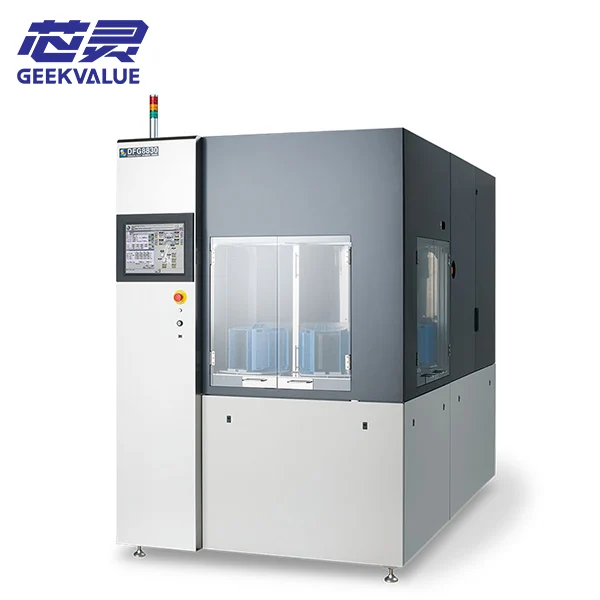
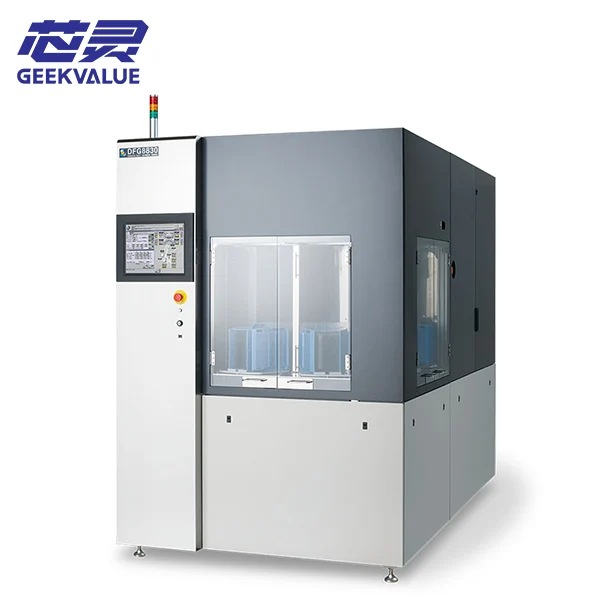
 The DISCO DFG8830 is a fully automated thinning and polishing machine for hard and brittle materials, launched by DISCO Corporation of Japan. Its core focus is on the efficient, low-damage thinning of third-generation semiconductor/optical hard and brittle materials such as SiC and sapphire. Featuring a 4-axis, 5-stage architecture, it balances high throughput and high precision, making it a mainstream machine for thinning 6-8 inch hard and brittle wafers.
I. Core Positioning and Application Scenarios
1. Core Positioning
A fully automated polishing and thinning machine specifically designed for high-hardness, high-brittle materials (SiC, sapphire, ceramics, glass, etc.), solving the pain points of low processing efficiency, high damage, and low yield of traditional equipment.
2. Typical Applications
Semiconductors: Thinning of SiC/GaN power wafers (6-8 inches), thinning of sapphire substrates (LED chips).
Optics: Thinning of optical glass, ceramic substrates, and infrared materials.
Advanced Packaging: Thinning of composite wafers with glass/ceramic support substrates (total thickness ≤ 3.5mm).
3. Compatible Sizes
Processed Wafers: Φ4/5/6 inches (maximum Φ150mm).
Supporting Substrates: Φ5/6/8 inches (compatible with 8-inch substrates supporting 6-inch wafers).
II. Overall Structure and Core Configuration
1. Overall Architecture
Layout: 4 spindles + 5 chuck tables + 1 rotary table, integrating the entire process of loading, grinding, cleaning, drying, and unloading, occupying only 3.5㎡, compact and efficient.
Dimensions (W×D×H): 1400×2500×2000mm; Weight: Approximately 6000kg.
2. Core Components
(1) Spindle System (4 axes, Z1-Z4)
Power: Z1-Z3 are 6.3kW (high rigidity, high torque, suitable for heavy loads on hard and brittle materials); Z4 is the finishing axis. Rotation speed: 1000-4000 min⁻¹ (constant power output, suitable for rough/fine grinding).
Grinding wheel: Standard Φ300mm diamond grinding wheel (large diameter, high removal rate, suitable for hard and brittle materials).
(2) Worktable system
5 vacuum suction cup worktables and 1 rotary table enable parallel processing and continuous operation, with a UPH (upper capacity per hour) three times that of single-axis equipment (such as DFG8340).
Vacuum adsorption + positioning accuracy ±2μm ensures that the TTV (total thickness deviation) of the wafer after thinning is ≤2μm.
(3) Control system
Operating interface: 15-inch touch GUI, icon-based operation, supports real-time monitoring, parameter storage, and abnormal alarms.
Control core: High-precision servo + grating closed-loop, thickness control accuracy ±0.1μm, supports micron-level thinning (down to 50μm). 3. Key Modules
Grinding Module: 4-axis division of labor (Z1 rough grinding → Z2 medium grinding → Z3 fine grinding → Z4 polishing/finishing), completing multiple processes in a single clamping, reducing handling damage.
Cleaning and Drying Module: Pure water spraying + ion air drying after grinding, leaving no residue or watermarks, meeting semiconductor cleanliness requirements.
Automatic Loading and Unloading: Dual material boxes (25 wafers per box), automatically identifying wafers/substrates, reducing manual intervention.
III. Working Principle and Process Flow
1. Grinding Principle
Employs wafer rotation + in-feed grinding method: The wafer rotates at high speed with the worktable, and the diamond grinding wheel feeds axially, removing material through abrasive cutting + micro-fracture. For hard and brittle materials, brittle removal is the primary method, supplemented by plastic removal, controlling crack depth ≤5μm.
2. Standard Process Flow
Loading: A robotic arm picks up the wafer from the material box → positions it → vacuum adsorbs it onto the worktable.
Coarse Grinding (Z1): High removal rate (50-100μm/min), rapidly thinning to target thickness + 20μm.
Medium Grinding (Z2): Medium removal rate (20-50μm/min), reducing the damaged layer to target thickness + 5μm.
Fine Grinding (Z3): Low removal rate (5-10μm/min), TTV ≤ 2μm, damaged layer ≤ 2μm.
Polishing/Surface Finishing (Z4): Mirror finish, surface roughness Ra ≤ 0.1μm.
Cleaning and Drying: Pure water spray → ion air drying → unloading into the material box.
3. Support Substrate Processing Flow: Adapts to glass/ceramic substrate composite wafers (total thickness ≤ 3.5mm), vacuum adsorption of the substrate protects the front side of the wafer, grinding only the back side, solving the warping and breakage problems of ultra-thin wafers.
IV. Core Technological Advantages
1. Strong Adaptability to Hard and Brittle Materials
High-power spindle (6.3kW) + large-diameter diamond grinding wheel, increasing SiC/sapphire processing efficiency by 3 times and extending wheel life by 50%.
Low-damage grinding process: Damage layer ≤2μm, yield ≥99%, far exceeding traditional lapping processes.
2. High-efficiency production capacity (4 axes, 5 worktables)
Parallel processing: 4 axes working simultaneously, 5 worktables continuously rotating, UPH≥30 wafers (6-inch SiC), 3 times that of single-axis equipment.
Fully automated: Integrated loading, unloading, grinding, cleaning, and drying; unattended continuous operation for 24 hours.
3. High precision and high stability
Thickness control: ±0.1μm, TTV≤2μm, meeting automotive-grade SiC wafer requirements.
Rigid structure: Cast iron body + vibration damping design, vibration ≤0.5μm, no drift in accuracy during long-term operation. 4. Flexible Adaptability and Low Operating Costs
Multi-size Compatibility: Compatible with 6-inch wafers and 8-inch substrates, allowing for multi-purpose use and reducing equipment investment.
Green Processing: Uses only pure water, eliminating polishing slurry pollution; wastewater can be directly discharged, reducing operating costs by 30%.
V. Key Technical Parameters Table
Table Parameter Value
Processing Wafer Size Φ4/5/6 inches (maximum Φ150mm)
Support Substrate Size Φ5/6/8 inches
Number of Spindles / Power 4 axes, Z1-Z3: 6.3kW
Spindle Speed 1000-4000min⁻¹
Grinding Wheel Specification Φ300mm Diamond Grinding Wheel
Thickness Control Accuracy ±0.1μm
TTV (Total Thickness Deviation) ≤2μm
Surface Roughness Ra≤0.1μm
Capacity (6-inch SiC) UPH≥30 wafers
Overall Machine Dimensions (W×D×H) 1400×2500×2000mm
Weight Approx. 6000kg
Floor Area 3.5㎡
VI. Comparison with Similar Equipment (DFG8830 vs DFG8340)
Table Comparison Item DFG8830 (4 axes, 5 worktables) DFG8340 (1-axis, 2-stage)
Spindle configuration: 4×6.3kW, roughing/finishing/polishing division: 1×4.2kW, single process
Capacity: UPH≥30 wafers (6-inch SiC), UPH≤10 wafers (6-inch SiC)
Processing accuracy: TTV≤2μm, damage layer≤2μm, TTV≤5μm, damage layer≤5μm
Suitable materials: SiC, sapphire, composite wafers (with substrate), silicon wafers, low-hardness ceramics
Legacy: 3.5㎡, 2㎡
Applicable scenarios: Mass production, high-hardness and brittle materials; Small batch, silicon wafers/low-hardness materials
VII. Summary and Industry Value
The DISCO DFG8830, with its 4-axis, 5-stage architecture, high-power spindle, and low-damage process, has become a benchmark equipment for the thinning of third-generation semiconductors (SiC/GaN) and sapphire optical substrates, solving the industry pain points of low efficiency, high damage, and low yield in the processing of hard and brittle materials. In fields such as new energy vehicles, 5G communications, and LED lighting, the DFG8830 helps SiC power devices and sapphire LED chips achieve mass production, driving the semiconductor industry towards wider bandgap, thinner profiles, and higher performance.