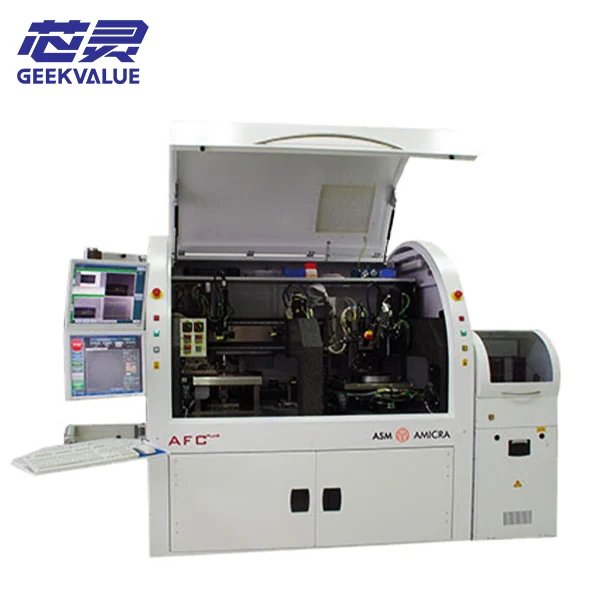



Epoxy Die Attach
The die is picked, aligned and attached to a substrate with an adhesive material.
Review the incoming die format, pickup tooling, adhesive-transfer method, substrate holding and any curing-related requirement.
ave up to 70% on SMT Parts – In Stock & Ready to Ship
Get Quote →Start with a current machine, then compare its installed handling, process modules, tooling and available evidence with your die-bonding requirements.
The goal is to identify which physical unit is worth further review, what is already confirmed and what still needs clarification before quotation.
Open the equipment record below, then compare its installed configuration with your project requirements.
Start with the physical AFC Plus machines currently published on this page. Each record should be reviewed separately for identity, installed configuration, tooling, available evidence and quotation scope.
You do not need to define every machine option at the beginning. Select the process direction that most closely describes the project, then focus the machine review on the structures that can affect that route.
The die is picked, aligned and attached to a substrate with an adhesive material.
Review the incoming die format, pickup tooling, adhesive-transfer method, substrate holding and any curing-related requirement.
The connection depends on controlled heating, defined contact conditions or a eutectic bonding path.
Review the installed heating arrangement, temperature-control equipment, bonding tools, substrate support and available thermal-system evidence.
The die must be turned and bonded with its active side facing the substrate.
Review the installed flipping and transfer arrangement, vision relationship, software functions, bonding tools and included accessories.
The process direction shows what the project may require. The next step is to compare those requirements with the real configuration of the selected physical machine.
Compare the project with the machine →GEEKVALUE compares the information available from the project with the configuration, tooling and evidence available for the individual machine. Unknown items remain unconfirmed rather than being assumed.
What is being bonded, its approximate dimensions and how the die is presented to the process.
Epoxy die attach, eutectic bonding, flip chip bonding or another already defined route.
What receives the die and whether special holding, support or heating conditions are required.
The intended orientation, alignment result, inspection requirement and next production step.
The real loading, pickup, transfer and orientation equipment present on the machine.
The installed bonding, heating, adhesive-transfer or flip-chip-related structures.
The known alignment, mapping, inspection and program functions available on the unit.
The included tools, fixtures, files, photographs and any additional machine review that can be discussed.
The review should show whether the selected machine is worth further evaluation and which questions must be resolved before the equipment and delivery scope are finalized.
A complete process specification is not required for the first inquiry. Four basic pieces of information are enough to begin a machine-specific discussion.
Describe the die, component or assembly in simple terms.
Share whether it comes from a wafer, tray, carrier or another presentation format.
State whether the project uses epoxy, eutectic, flip chip or another known process.
Add an existing machine, drawing, tool, process photo or sample description when available.
These answers focus on the questions that affect whether a physical machine should move forward to quotation or further review.
No. Machines with the same model name may differ in handling equipment, process modules, vision functions, software, tooling, accessories and condition. Each physical unit should be reviewed separately.
The initial review compares available project information with the known machine configuration and identifies remaining questions. It does not replace complete process validation or guarantee production results.
The item should remain unconfirmed rather than being assumed. Additional photos, configuration records, remote video or an agreed test review may be discussed according to access, location, tooling and operating condition.
No. Begin with what is being bonded, how the die is supplied, the planned bonding method and any useful reference. More detailed questions can be handled after a specific machine is selected for further review.
Why do so many people choose to work with GeekValue?
Our brand is spreading from city to city, and countless people have asked me, "What is GeekValue?" It stems from a simple vision: to empower Chinese innovation with cutting-edge technology. This is a brand spirit of continuous improvement, hidden in our relentless pursuit of detail and the delight of exceeding expectations with every delivery. This almost obsessive craftsmanship and dedication is not only the persistence of our founders, but also the essence and warmth of our brand. We hope you will start here and give us an opportunity to create perfection. Let us work together to create the next "zero defect" miracle.
DetailsContact a sales expert
Reach out to our sales team to explore customized solutions that perfectly meet your business needs and address any questions you may have.