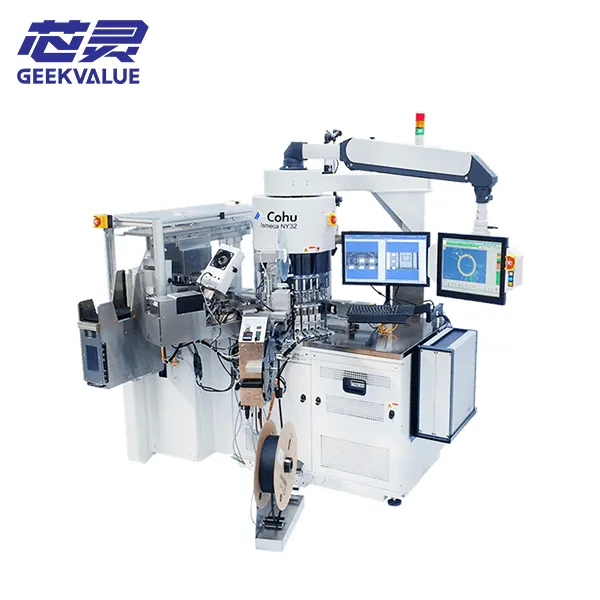
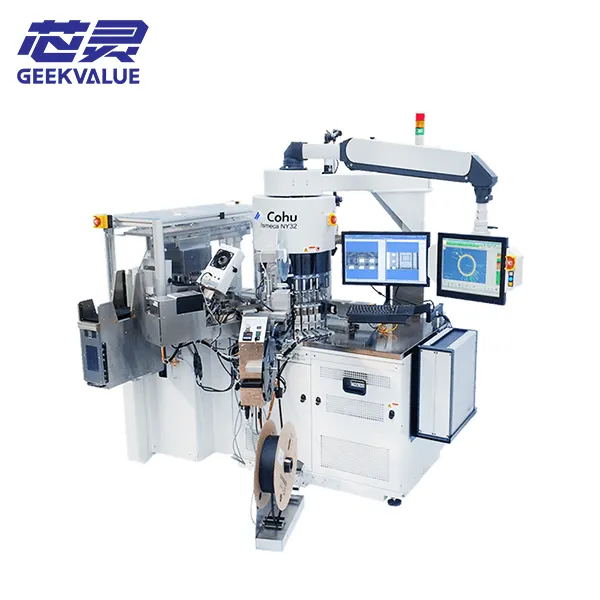
 The ISMECA NY32 is a 32-station rotary semiconductor testing/sorting/inspection system from ISMECA (now part of Cohu), Switzerland. It is designed for high-integration, high-volume, and high-precision back-end packaging and final testing scenarios, and is a core piece of equipment for mass production of RF, analog, power devices, and advanced packaging.
I. Working Principle (Rotary Parallel Processing)
The NY32 uses a 32-station precision rotary table to automate the entire testing, inspection, and sorting process through "parallel stations + synchronous rotation":
Feeding: Pallet/tube/reel feeding, with visual positioning and posture correction.
Rotary Rotation: 32 stations rotate synchronously, sequentially completing 6-sided optical inspection → infrared flaw detection → 3D morphology measurement → electrical testing → marking → sorting.
Core Actions:
Vision: High-speed camera + infrared penetration, detecting appearance/size/cracks.
Testing: Probe card contact, completing DC/RF/parameter testing.
Sorting: Categories are sorted by quality (Good/Defective/Grade) and output to reels/tubes/pallets.
Data Loop: The PAICe digital twin platform monitors in real time, and AI algorithms automatically correct parameters.
II. Core Specifications (2026 Standard Configuration)
1. Capacity and Workstations
Number of Workstations: 32 parallel workstations
Maximum Capacity: 30,000 UPH (units/hour)
Test Stations: Up to 16 (parallel testing)
MTBA (Mean Time Between Maintenance): >120 min, high stability
2. Package Compatibility
Size: 0.3×0.6 mm ~ 17×17 mm
Type: QFN/DFN, SOIC, SOT, SC, LED, MEMS, WLCSP, Bare Die
Ultra-thin Processing: Supports 50 μm thin dies (NY32W version)
3. Inspection and Testing Capabilities
Vision System: NV-Core platform, 6-sided optical + infrared inspection
3D Inspection: 3D Flex® technology, 3D topography measurement of spheres/bumps
Infrared Flaw Detection: Penetrates silicon to detect internal cracks/hidden cracks
Electrical Testing: DC/RF/ Power testing, up to 3,500 V (power version)
4. Mechanical and Interconnectivity
Dimensions (W×D×H): Approx. 1,800×1,500×1,800 mm
Weight: Approx. 1,200 kg
Communication: SECS/GEM, KISS, PAICe digital twin (Industry 4.0 standard)
Changeover time: 20–60 minutes, adaptable to mixed production lines
III. Core Functions (Application Scenarios)
NY32 focuses on semiconductor back-end packaging final testing. Its core function is to complete electrical testing, appearance inspection, grade sorting, and packaging of chips/devices. Typical applications include:
RF devices: Mobile phone/IoT RF chips, Bluetooth/Wi-Fi modules
Analog/Mixed-signal ICs: PMIC, sensors, operational amplifiers, ADC/DAC
Power devices: MOSFET, IGBT, SiC/GaN wide bandgap devices (NY32W version)
Optoelectronics: LED, Mini LEDs, Laser Diodes, Optical Modules
Advanced Packaging: WLCSP, Bare Die, FC (Flip Chip), MEMS
Automotive Electronics: Automotive Chips (AEC-Q100), Sensors, Power Modules
IV. Main Functions
1. End-to-End Integration (Core Selling Point)
One-Stop Service: Loading → 6-Sided Inspection → Infrared Flaw Detection → 3D Measurement → Electrical Testing → Marking → Sorting → Packaging
Parallel Processing: 32-station synchronous operation, efficiency far exceeding serial equipment
2. NV-Core Advanced Vision Inspection
6-Sided Full Coverage: Top/Bottom/4 Side Appearance, Dimensions, Defect Inspection
Infrared Penetration: Detects internal cracks, voids, and hidden cracks in silicon materials, improving yield
3D Flex®: Precise measurement of BGA ball height, coplanarity, and bump morphology (accuracy ±5 μm)
OCR/Barcode: Laser marking recognition, 2D code traceability
3. Multi-mode Electrical Testing
Parallel Testing: Up to 16 test stations, significantly reducing testing time
Parameter Coverage: DC (IV), AC (CV), RF (S-parameters), power, temperature characteristics
Three-Temperature Testing: Room temperature / High temperature / Low temperature (-40℃ to +150℃), meeting automotive-grade requirements
4. Intelligent Sorting and Packaging
Multi-bin Sorting: Up to 16 levels, categorized by parameters / yield
Output Adaptation: Tape & Reel, Tube, Tray, Bulk
Automatic Reel Change: ARC automatic reel change, reducing downtime
5. Industry 4.0 and Intelligentization
PAICe Digital Twin: Real-time monitoring, remote diagnostics, predictive maintenance
DI-Core Data Intelligence: Yield analysis, process optimization, anomaly warning
AI Algorithm: Automatic defect type identification, parameter drift correction, changeover self-learning
V. Core Advantages (Comparison with NY20 / Competitors)
1. **Capacity King, Unrivaled Efficiency:**
30,000 UPH, 30% higher per unit area than NY20 (50,000 UPH, but fewer workstations).
Parallel testing + parallel inspection, one unit is equivalent to 2-3 serial devices.
2. Top-Tier Inspection Accuracy, Guaranteed Yield:
6-sided + infrared + 3D full-dimensional inspection, defect miss rate <0.01%. Infrared penetration detection of internal microcracks, impossible with traditional equipment.
3D measurement accuracy ±5 μm, meeting the stringent requirements of advanced packaging.
3. Flexible Adaptability, Rapid Changeover:
Coverage from 0.3×0.6 mm ultra-small to 17×17 mm ultra-large packages.
20-60 minute rapid changeover, the first choice for multi-variety, small-batch mixed lines.
Supports special scenarios such as gold/copper/silver alloy wires, thin dies, and power devices.
4. High Stability, Low Maintenance Costs:
MTBA > 120 min, continuous operation > 720 24-hour trouble-free operation
Modular design, simple maintenance, universal parts, and low long-term cost
5. Data-driven, intelligent manufacturing
Digital twin + AI algorithm enables predictive maintenance and process self-optimization
Full-process data traceability meets automotive/industrial quality certifications (such as AEC-Q100, ISO 26262)
VI. Selection Recommendations
Preferred NY32: RF/analog ICs, power devices, LEDs, advanced packaging, high-volume, high-yield requirements
Preferred NY32W: WLCSP, bare die, ultra-thin chips (50 μm), wide bandgap devices (SiC/GaN)
Preferred NY20: Ultra-high-speed short test time (<100 ms), discrete devices, ultra-mass LED production