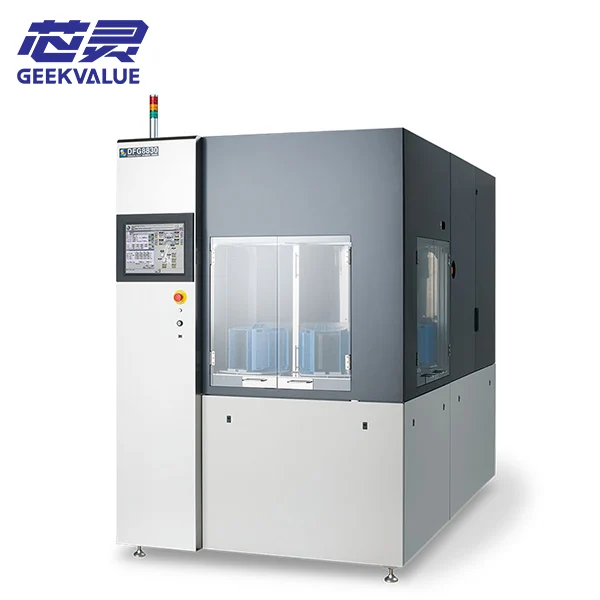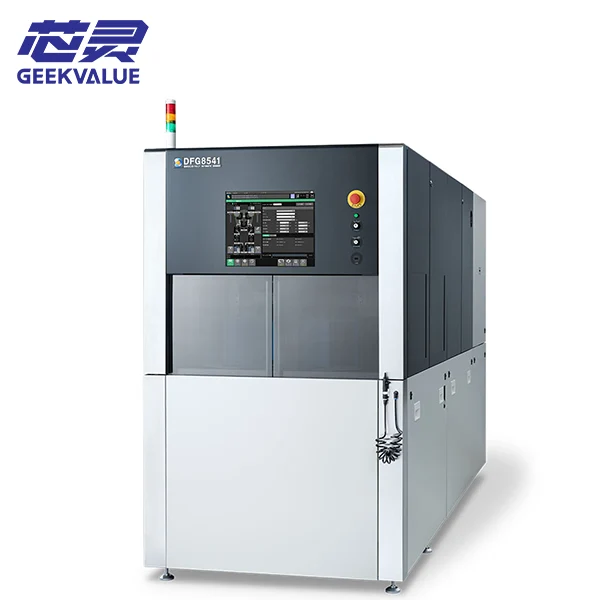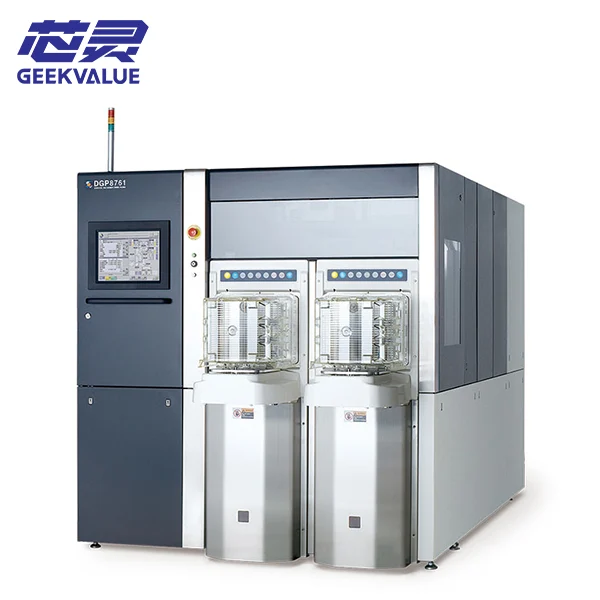
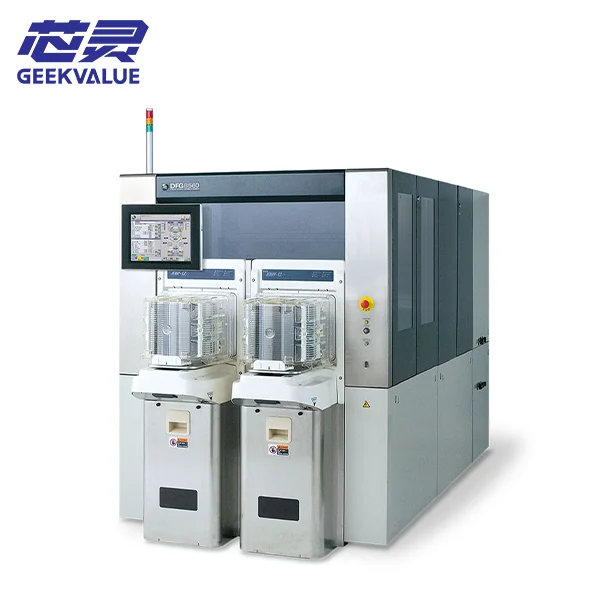
 As an upgrade to the DFG800 series, the DISCO DFG8560 is a fully automated wafer thinning machine. It is specifically designed to meet the challenges of 12-inch wafer thinning. Its core operating principle is based on a dual-spindle and triple-chuck configuration, completing both the "rough grinding" and "fine grinding" stages of the thinning process in a single wafer clamping operation. This design significantly improves processing efficiency and precision control.
**Working Principle**
The DFG8560 achieves wafer thinning through high-precision mechanical motion:
**High Rigidity Structure:** The machine employs a high-rigidity air-bearing spindle, ensuring excellent stability throughout the grinding process.
**Two-Step Grinding Process:**
**Rough Grinding:** The first spindle uses a coarser-grit wheel (e.g., resin-bonded diamond wheel). High-speed rotation quickly removes most of the material from the back side of the wafer, maximizing efficiency.
**Fine Grinding:** The second spindle uses a finer-grit wheel (e.g., ceramic-bonded diamond wheel) for precision grinding of the wafer. This process creates a smooth, flat surface and removes the damaged layer produced during the rough grinding stage.
In actual operation, the wafer is held in place on a rotating chuck by vacuum suction. The chuck rotates in the opposite direction to the high-speed grinding wheel; the wheel moves vertically downwards, cutting the wafer surface.
**Key Features**
The core function of the DFG8560 is wafer thinning. To this end, it integrates a series of key functions:
**Fully Automated Operation:** This equipment automates the entire workflow from wafer loading, alignment, grinding, cleaning to unloading, significantly reducing manual intervention and improving production efficiency.
**High-Precision Thickness Control:** By integrating a high-resolution (0.1 μm) online thickness measurement system, the equipment achieves closed-loop control of the grinding process, ensuring the accuracy of the final wafer thickness.
**Ultra-Thin Wafer Processing:** By optimizing grinding and processing system parameters, the DFG8560 can stably process ultra-thin wafers with a thickness of 100 μm or less, while minimizing the risk of wafer breakage.
**Defect Detection:** This system can identify defects on the wafer surface, providing necessary data support for subsequent repair processes or feedback loops.
**User-Friendly Interface:** Equipped with a touchscreen LCD and a graphical user interface (GUI), the system displays processing and equipment status in real time, making operation and maintenance simpler and more intuitive.
**Online Integration and Expansion:** The DFG8560 can be seamlessly integrated into more complex automated production lines, such as:
**DBG (Post-Die Grinding) System:** Integrates dicing and thinning processes, making it particularly suitable for the manufacture of ultra-thin chips.
**Dry Polishing Machine (e.g., DFP8160):** Forms an integrated system that performs dry polishing after grinding processes, further reducing wafer surface roughness (Ry value) and eliminating damage caused by grinding.
**Wafer Laminator/Stripper:** Integrated to automatically apply or remove protective polishing films, creating a complete automated workflow.
**SECS/GEM Communication:** This device supports the SECS/GEM communication protocol, enabling connection to a factory Manufacturing Execution System (MES) for remote monitoring and automated production data acquisition.
**Applications and Functions:**
The primary function of the DFG8560 is to provide wafers with uniform thickness and excellent surface quality for subsequent processes such as dicing and packaging; its broad material compatibility also makes it suitable for a wide range of applications.
**Wafer Thinning:** Reducing wafer thickness from its original thickness to a target thickness—a fundamental requirement for almost all applications.
**Damage Layer Removal:** Eliminating stress-damaged layers generated in upstream processes (such as back-side grinding)—a critical step in ensuring the mechanical strength of the chip.
**Surface Planarization:** Providing a highly flat substrate for subsequent precision processes (such as photolithography and bonding)—a prerequisite for high-precision manufacturing.
**3D Packaging and TSV Exposure:** Providing the thin wafers required for realizing Through-Silicon Vias (TSV) technology and precisely exposing the bottom of the TSV structure—a core component of advanced packaging.
Power and RF Device Manufacturing: Used for thinning SiC, GaN, and other compound semiconductor wafers to reduce on-resistance and improve heat dissipation.
Optical Device and Filter Fabrication: Used for precision thinning and planarization of hard and brittle materials such as sapphire (LED substrate) and lithium tantalate/lithium niobate (RF filter).
Detailed Specifications
Specifications Specifications
Applicable Workpiece Size: Φ300 mm (12 inches). Universal chuck supports Φ200 mm/Φ300 mm wafers.
Grinding Method: Wafer rotation longitudinal in-feed grinding.
Spindle Configuration: Dual spindles (2 axes). Built-in high-frequency motor-driven air-static spindle.
Chuck Table Configuration: Three chuck tables, using a rotary table system. Chuck speed: 0-300 rpm.
Spindle Power: Rated output 4.8 kW.
Spindle Speed: 1,000 - 4,000 min⁻¹ (rpm).
Z-axis travel: 120 mm (including origin).
Z-axis grinding feed rate: 0.0001 - 0.08 mm/s (0.1 - 80 μm/s).
Minimum Z-axis movement: 0.1 μm.
Thickness measurement range: 0 - 1,800 μm.
Thickness measurement resolution: 0.1 μm.
Thickness measurement repeatability: ±0.5 μm.
Grinding wheel specifications: Φ300 mm diamond grinding wheel.
Intra-wafer thickness deviation (TTV): Less than 3.0 μm (using a dedicated worktable, φ300 mm wafer).
Inter-wafer thickness deviation: Less than ±3.0 μm.
Surface roughness after finishing: Ry approximately 0.13 μm (using #2000 grinding wheel); Ry approximately 0.15 μm (using #1400 grinding wheel).
Equipment dimensions (W × D × H): Approximately 1,400 × 3,190 × 1,800 mm.
Equipment weight: Approximately 4,000 kg.
Required power: Three-phase 200/220/380/400 V, 50/60 Hz, maximum power consumption approximately 22 kVA.
Required compressed air: Above 0.5 MPa, clean and oil-free, dew point below -15℃, flow rate approximately 1,000 NL/min.
Water supply requirements: DI water (deionized water), temperature 23±1℃, flow rate 6-10 L/min.
Core Advantages
The DFG8560 continues to solidify its market position as a high-performance wafer thinning equipment with the following advantages:
High grinding precision: Through optimized design, grinding quality is effectively improved, achieving excellent intra-wafer thickness uniformity (TTV) and inter-wafer consistency, ensuring performance for demanding processes such as advanced packaging.
Stable Grinding Quality: Optimized grinding and handling parameters enable stable ultra-thin wafer grinding, effectively controlling the breakage rate, which is crucial for high-value large-size wafers.
Superior Scalability: Offers a wealth of in-line integration options (such as DBG and dry polishing), flexibly adapting to production line upgrades and fully protecting user investment.
Strong Compatibility: Capable of handling various materials (such as silicon, SiC, GaN, sapphire, LT/LN), providing significant process flexibility for manufacturing various semiconductors and optoelectronic devices.
User-Friendly and Easy-to-Maintain: A user-friendly GUI and touchscreen greatly lower the operating threshold. Meanwhile, key components are interchangeable with the 800 series, reducing spare parts inventory costs and downtime risks.
Lightweight Design: A 1.0-ton weight reduction (approximately 20%) was achieved while maintaining specifications and performance. The lighter equipment simplifies the installation process and reduces the load-bearing requirements of the factory floor.
Technical Features Summary: Dual-Axis Three-Suction Cup Design: Separates rough grinding and fine grinding, completing them in a single clamping operation, improving efficiency while ensuring accuracy.
Air-static spindle: Utilizing an air-static spindle, this design eliminates mechanical contact, resulting in minimal wear and maintaining high rotational accuracy over extended periods. It is a core component for achieving ultra-high machining precision.
Dual grinding point alignment technology: This technology allows two spindles to share the same physical grinding position, eliminating systematic errors caused by processing point misalignment. This simultaneously improves thickness uniformity (TTV) within a single wafer and thickness consistency between wafers, making it a key technology for achieving stable ultra-thin grinding.
Summary: In conclusion, the DISCO DFG8560 is a fully automated 12-inch wafer thinning solution designed for mass production. Its key features include a precise dual-spindle architecture and superior system stability, enabling top-tier high uniformity and surface quality when processing large, ultra-thin wafers, along with powerful automation integration capabilities.