 EN
EN id
id sk
sk sr
sr sv
sv it
it pt
pt bn
bn ms
ms be
be nl
nl fr
fr th
th vi
vi ru
ru ja
ja ko
ko de
de hy
hy az
az bs
bs bg
bg my
my cs
cs da
da dv
dv el
el et
et fil
fil fi
fi ga
ga gl
gl gn
gn he
he hi
hi km
km hr
hr hu
hu is
is kn
kn rw
rw lo
lo lv
lv lt
lt lb
lb lg
lg mi
mi mt
mt ne
ne no
no ny
ny or
or om
om per
per pl
pl ro
ro sa
sa so
so es
es sw
sw ta
ta tr
tr uk
uk ur
ur cy
cy xh
xh
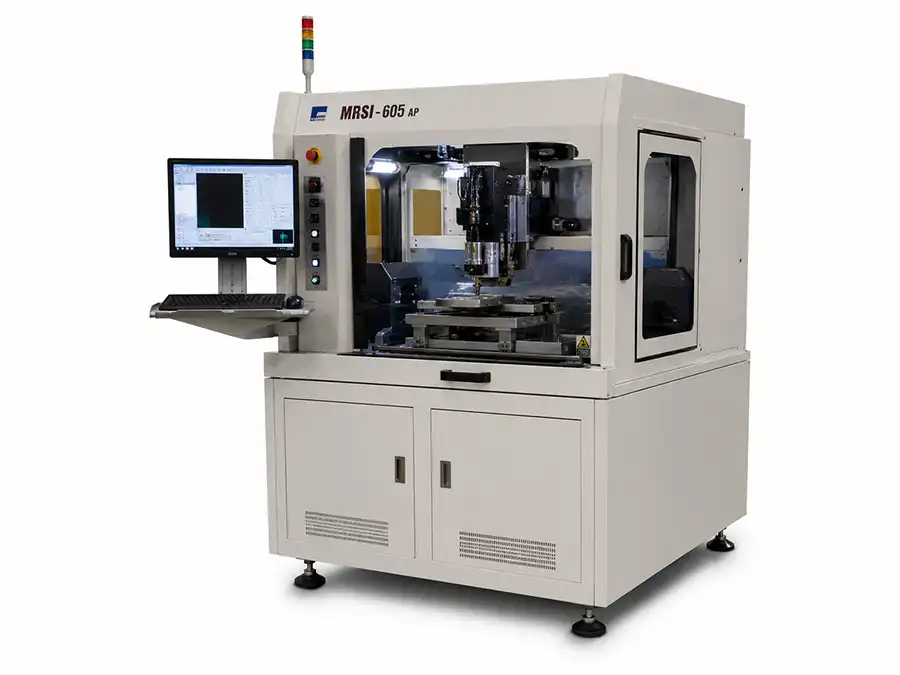
The MRSI-605 AP was a legacy advanced-packaging die bonder associated with automated epoxy die attach, eutectic bonding and flip-chip assembly. Information about the model is now found mainly in archived technical documents, older production records and used-equipment listings rather than on a current product page.
Historical material explains how the platform was designed, but it does not establish the configuration or present capability of a surviving machine. The nameplate, installed modules, tooling, software and physical condition determine what an individual unit can still perform.
The MRSI-605 AP is therefore best understood as a controlled assembly system in which mechanical stability, multi-tool handling, force feedback, machine vision and material presentation worked together.
What the MRSI-605 AP Was Designed to Do
Historical sources identify the MRSI-605 AP as an automated die-bonding platform for advanced semiconductor and hybrid assembly. Its role was to pick components, establish their orientation, align them with a substrate or package and complete the configured bonding step.
The shortened name MRSI-605 often appears in resale listings, but it does not confirm that a machine is the AP configuration described in archived technical material. The exact designation should be established from the machine plate and original records.
The platform was associated with several bonding directions rather than one fixed process. Epoxy die attach, eutectic bonding and flip-chip assembly placed different demands on component orientation, heating, material presentation, tooling and software.
This flexibility made the machine relevant to advanced-packaging work, but it also means that two similarly labelled units may have been configured for very different products and production routes.
A Stable Mechanical Foundation for Controlled Placement
Historical MRSI-605 AP documentation describes a granite-supported machine structure with the placement head mounted from above. This provided a stable mechanical reference for the motion, vision and bonding systems.
Granite offers a rigid, dimensionally stable base, while the overhead arrangement helps maintain a controlled relationship between the moving head, tooling and work area. These features do not create placement accuracy by themselves; they support the motion control, calibration, vision alignment and process tooling required to achieve it.
A historical source positioned the platform around 10-micron placement accuracy. That figure should remain tied to the original machine design and source context. It is useful for identifying the intended precision class of the platform, not for certifying the current performance of a used unit.
Present results would depend on the condition of the motion system, cameras, fixtures, calibration, software, tooling and process environment.
Multi-Tool Handling, Force Control and Machine Vision
The advanced-packaging role of the MRSI-605 AP came from the interaction of its tool turret, force-control system and vision functions. Together, these systems supported different component types and process steps within one assembly route.
Six-Head Feather-Touch Tool Turret
Historical documentation describes a six-head feather-touch tool turret. Keeping several tools available allowed an assembly sequence to use different pickup or placement tools without requiring manual replacement between every process step.
This could support multicomponent products or assemblies requiring several tool geometries. A fragile die might need a dedicated pickup collet, while another component or bonding stage could require a different contact surface.
Feather-touch should be understood as controlled low-force handling rather than a guarantee of safe contact for every device. Tool material, contact area, component thickness, surface sensitivity and calibration still determine whether the handling method is appropriate.
Closed-Loop Force Control
Closed-loop force feedback allowed the system to monitor contact during pickup, placement or bonding instead of relying only on a commanded vertical position.
This was particularly relevant to fragile compound-semiconductor devices such as GaAs and InP components, where excessive pressure could damage the die or disturb the assembly. The useful result still depended on the selected tool, calibration and bonding recipe.
Machine Vision and Local Alignment
Machine vision supported component recognition, orientation and relative alignment between the die and target. Historical descriptions refer to top-surface and bottom-feature alignment, which is important when relevant features cannot be viewed from only one direction.
For flip-chip assembly, lower-side interconnect features must be positioned relative to corresponding substrate features. Vision, tooling and component handling therefore operate as one system: the machine must hold the die safely, identify the required references and establish their relationship before bonding.
The turret made the necessary tools available, force control managed contact and vision established position. Their combined operation gave the MRSI-605 AP its value in multicomponent and precision advanced-packaging processes.
Material Presentation and Bonding Process Directions
Historical platform information associates the MRSI-605 AP with components supplied through waffle packs, Gel-Paks and standard wafers. Each format changes how parts are located, supported and picked.
Waffle packs organize individual components in defined pockets. Gel-Paks hold components on a tacky surface and may require a different pickup approach. Wafer input introduces die-position, support and separation requirements that must be coordinated with the handling sequence.
The corresponding stages, handlers, software and pickup tools depended on the machine configuration and intended process.
Epoxy Die Attach
In an epoxy process, bonding material must be presented or applied before controlled placement. The machine may have used dispensing or another material-transfer method together with tooling suited to the die and substrate.
The component then needs to be positioned and released without disturbing the material deposit. Process quality depends on the relationship between material application, placement, tool release and subsequent curing rather than on positioning movement alone.
Eutectic Bonding
Eutectic assembly introduces controlled heating and process-specific contact. Historical material also describes eutectic scrub in a specialized TO-package configuration, where controlled movement at the bond interface supported joint formation.
That documented arrangement used heated stages and a controlled gas environment. It represents a specialized application configuration rather than a universal MRSI-605 AP setup.
Flip-Chip Assembly
Flip-chip assembly changes the component orientation so that lower-side or interconnect features face the mating surface. This affects pickup, flipping, visual access, support, tooling and local alignment.
The platform’s historical association with flip-chip assembly shows that it could be configured for this direction, provided the necessary orientation hardware, optics, software and tools were present.
Historical Applications in Advanced Packaging
The MRSI-605 AP was associated with MEMS, advanced semiconductor packages, multichip modules, hybrid assemblies, microwave and RF circuits and photonics packaging.
These applications often combine small or fragile components with demanding alignment and tooling requirements. The platform was relevant because it brought together controlled placement, low-force handling, multiple tools, vision-supported alignment and flexible material presentation.
Application labels indicate the types of work for which the machine was used or promoted, but they do not establish compatibility with every device in those categories. Component geometry, substrate design, bonding material, process temperature, tooling and software define the real application.
Why a Legacy MRSI-605 AP May Still Be Relevant
A legacy machine may remain valuable when it supports an existing qualified production process. A factory may already have compatible tooling, established recipes, operator knowledge and process records built around the MRSI-605 AP.
Replacing that equipment with a newer platform can involve more than purchasing another bonder. Fixtures may need redesign, software and recipes may need redevelopment, and the product may require revalidation.
For low-volume or specialist assemblies, maintaining or replacing a familiar platform can sometimes create less disruption than transferring production immediately. Its value is greatest when tooling, process files and technical knowledge remain available.
Age also introduces risk. Controls, software, electronics and documentation may be incomplete, while replacement parts or manufacturer support may be limited. A machine that was valuable in its original production environment may be difficult to commission after being separated from its associated process assets.
Separate Historical Capability From the Actual Machine
Archived platform information should guide the evidence request rather than fill gaps in a used-equipment listing.
A machine-specific review should establish the exact nameplate designation, installed turret, available tool positions, pickup and bonding tools, material handlers, heated stages, process modules, vision configuration and software environment. Calibration, physical condition, records and serviceability must also be reviewed independently.
A complete-looking unit may still lack recipes, licenses, fixtures or application-specific tools that were essential to its previous production process.
Readers evaluating a real unit can move from platform research to the actual record for used MRSI-605 AP equipment. Contact the supplier by email or WhatsApp with the listing, machine photographs, nameplate, installed tooling, available software information and intended process.
Supporting photographs and technical documents can be attached after the conversation is opened. Configuration, compatibility, current accuracy, support and availability should only be discussed after the individual machine has been identified and reviewed.
Frequently Asked Questions About the MRSI-605 AP
What is the MRSI-605 AP?
It is a historically documented advanced-packaging die bonder associated with automated epoxy die attach, eutectic bonding and flip-chip assembly.
Is MRSI-605 the same as MRSI-605 AP?
Not necessarily. Historical technical references identify the AP model, while resale listings may shorten the name. The machine plate and original records should confirm the exact designation.
What placement accuracy was documented for the MRSI-605?
A historical source positioned the platform around 10-micron placement accuracy. This is a dated platform claim and does not establish the present performance of a used machine.
What was the six-head feather-touch turret used for?
It kept several application-specific tools available during multicomponent or multistep assembly, reducing the need for manual replacement between process stages.
Is the MRSI-605 AP still practical for production?
It may remain relevant when a qualified legacy process, compatible tooling, recipes and operator knowledge still exist. Machine condition, software, documentation, support and revalidation requirements need separate review.
Conclusion: The MRSI-605 AP was a flexible legacy advanced-packaging platform whose value came from the interaction of stable mechanics, multi-tool handling, closed-loop force control, machine vision and varied material presentation. Epoxy, eutectic and flip-chip assembly required different configurations rather than one universal setup. Historical specifications explain the platform’s intended role, while present-day value depends on the identity, installed hardware, software, tooling, condition and production context of the actual machine.