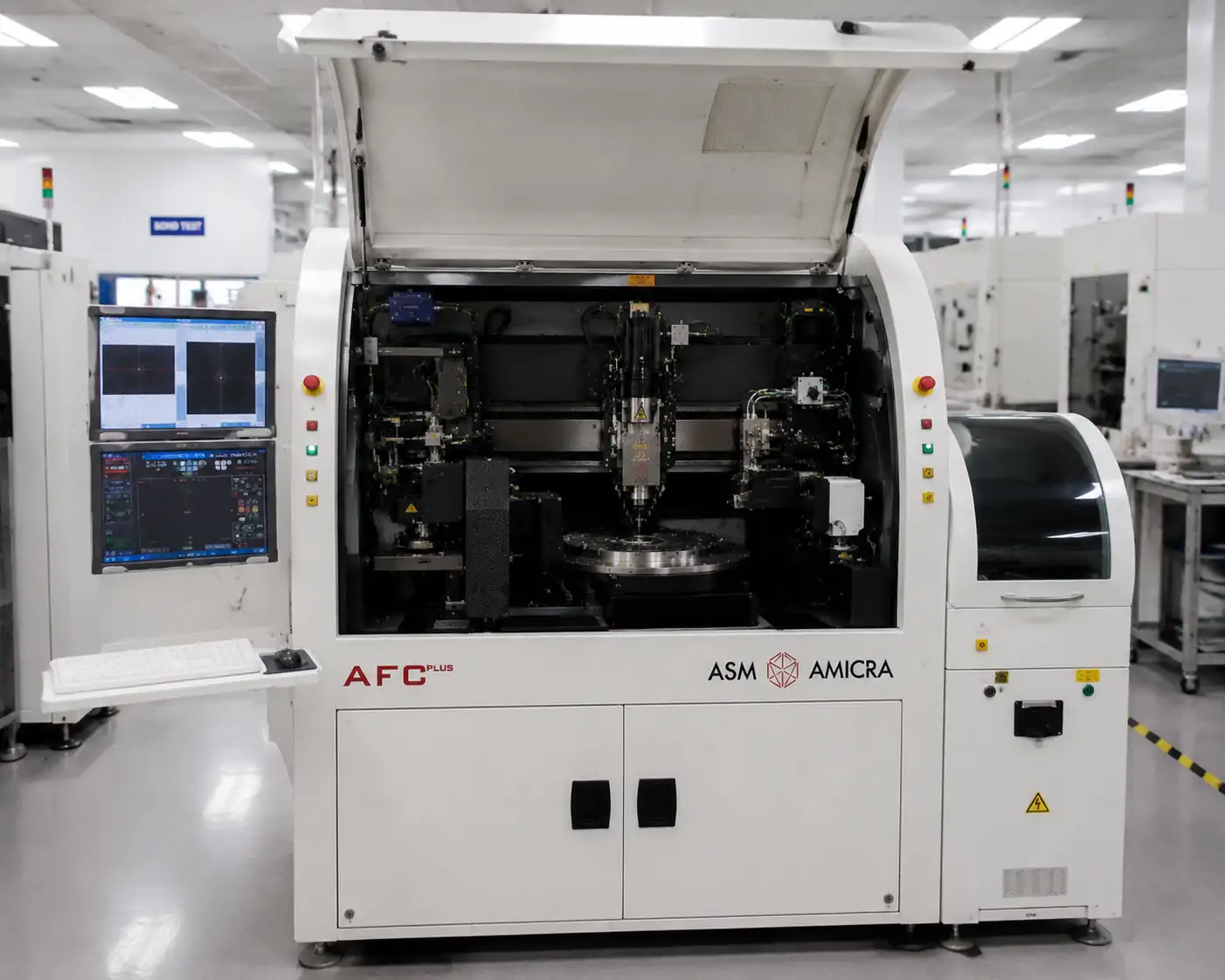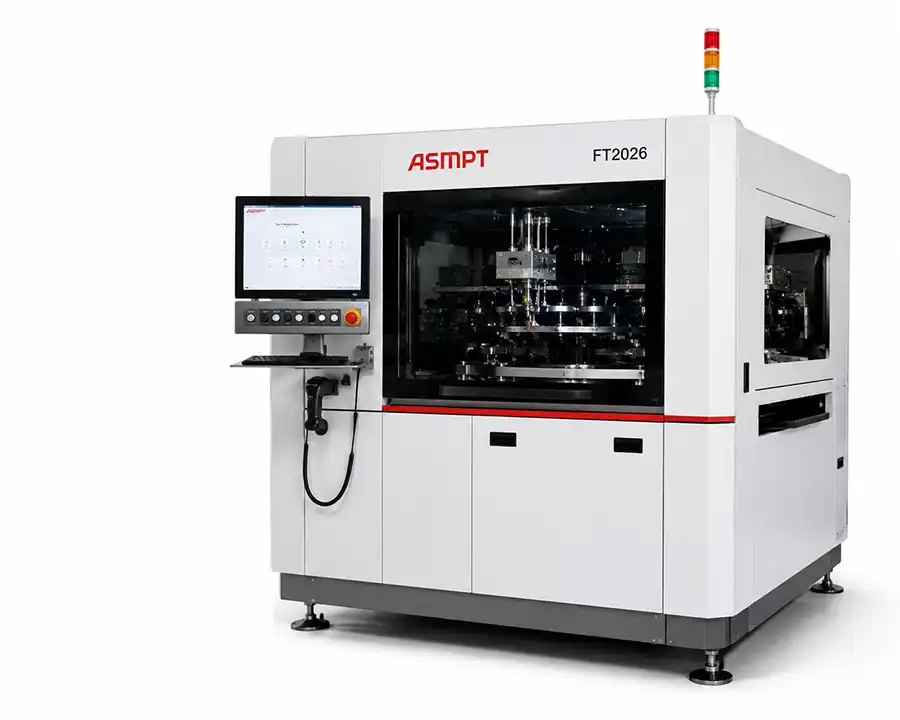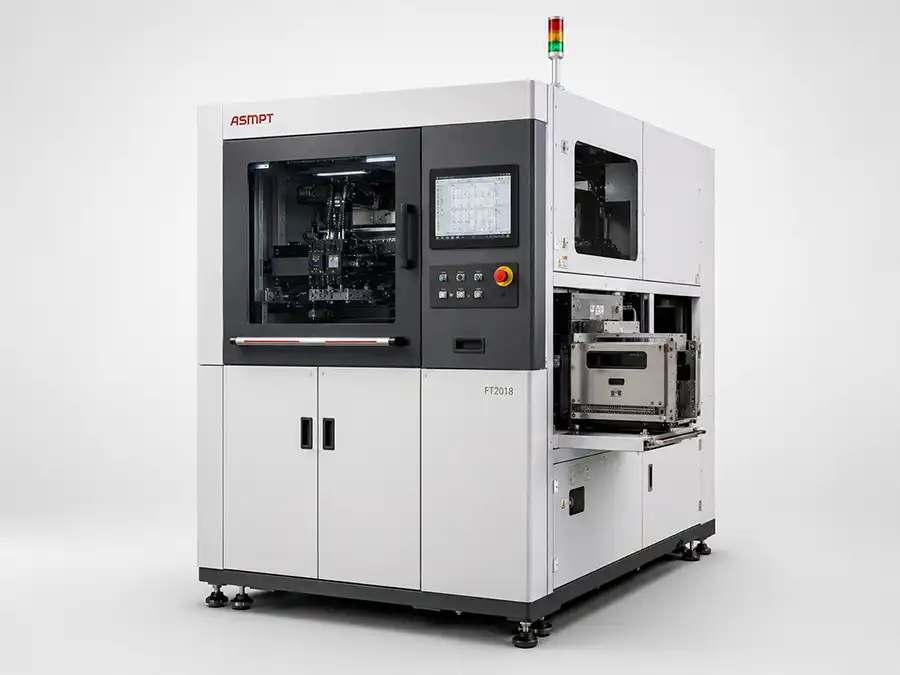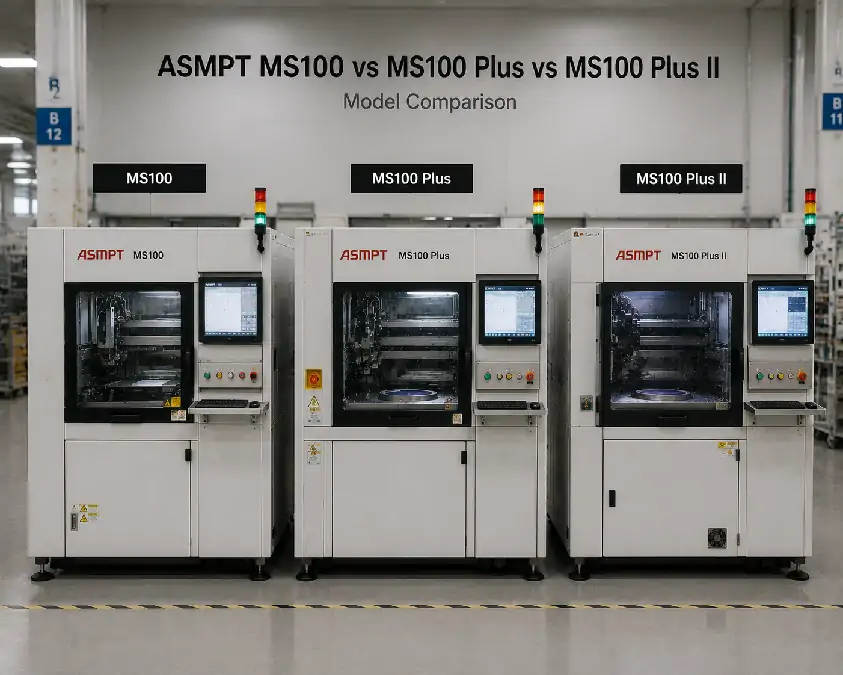
The ASMPT Test Handler is an automated semiconductor handling system designed to support efficient, accurate, and reliable semiconductor testing operations. In modern semiconductor manufacturing, test handlers play an important role by managing device transportation, positioning, environmental control, and product classification during the testing process.
As semiconductor devices continue to become more advanced, manufacturers require automated test handling systems that can improve production consistency, reduce manual intervention, and support complex semiconductor packages. An ASMPT Test Handler helps connect semiconductor devices with testing equipment while maintaining stable manufacturing workflows.
This guide explains what an ASMPT Test Handler is, its main functions, key components, applications, and the important factors engineers should consider when evaluating semiconductor test handling solutions.
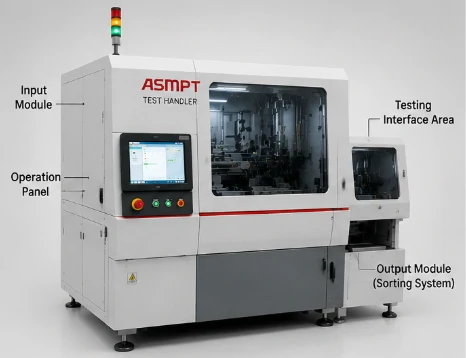
What Is an ASMPT Test Handler?
An ASMPT Test Handler is a specialized semiconductor automation machine used to manage the physical movement and processing of semiconductor devices during testing operations.
The system works together with semiconductor testers to ensure that integrated circuits (ICs), memory devices, advanced packages, and other semiconductor components can be tested under controlled and repeatable conditions.
Unlike a standard material transportation system, a semiconductor test handler combines multiple functions, including:
Automated device handling.
Precision positioning.
Temperature management.
Testing interface coordination.
Device sorting and classification.
Production data communication.
The main purpose of an ASMPT Test Handler is to create a reliable connection between semiconductor devices and testing systems while maintaining high production efficiency.
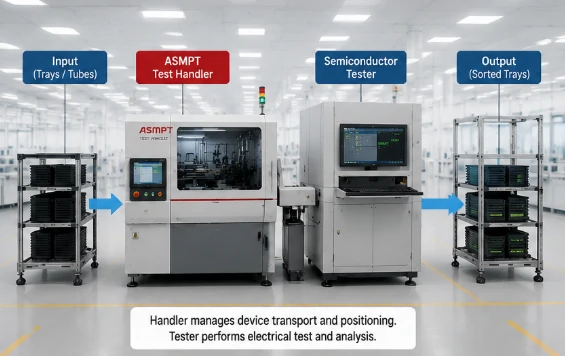
The Role of Test Handlers in Semiconductor Manufacturing
Semiconductor manufacturing includes several important stages, such as wafer fabrication, assembly, packaging, testing, and final quality verification.
Test handlers are mainly used during the semiconductor testing stage after devices have completed packaging. At this stage, manufacturers need to verify whether semiconductor products meet electrical, functional, and reliability requirements.
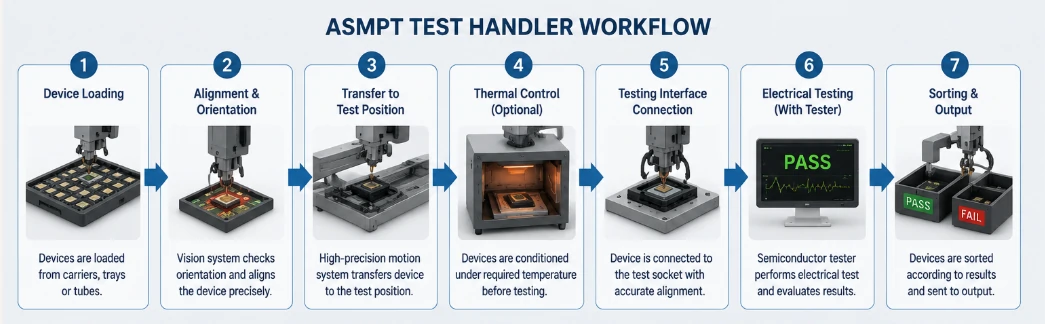
The test handler manages the physical operations required before, during, and after testing, including:
Receiving packaged semiconductor devices.
Moving devices into testing positions.
Maintaining required test conditions.
Sorting devices according to test results.
Preparing products for the next manufacturing step.
Without automated handling equipment, semiconductor testing would become slower, less consistent, and more dependent on manual operations.
Main Functions of ASMPT Test Handler Systems
An ASMPT Test Handler performs multiple functions that support automated semiconductor testing. These functions work together to improve testing reliability, production efficiency, and manufacturing consistency.
| Function | Description | Manufacturing Value |
|---|---|---|
| Device Handling | Automatically transfers semiconductor devices between input, testing, and output locations. | Improves production efficiency and reduces manual handling. |
| Precision Positioning | Places devices accurately into testing interfaces. | Supports reliable electrical connection and accurate test results. |
| Temperature Management | Controls device temperature during specific testing requirements. | Enables evaluation under different operating conditions. |
| Sorting and Classification | Separates devices according to testing results. | Improves production organization and quality control. |
| System Integration | Communicates with testers and factory automation systems. | Supports automated manufacturing workflows. |
Automated Device Handling
One of the primary functions of an ASMPT Test Handler is automated semiconductor device movement. The system replaces manual loading and transportation processes with controlled mechanical operations.
Automated handling helps manufacturers achieve:
Consistent device movement.
Reduced operator involvement.
Lower risk of handling damage.
Stable high-volume production.
Precision Positioning Control
Semiconductor testing requires accurate positioning because devices must establish reliable connections with testing interfaces.
The handler ensures that semiconductor packages are placed correctly to maintain stable contact during testing.
Positioning accuracy affects:
Electrical connection quality.
Testing repeatability.
Production yield.
Equipment reliability.
Temperature Control Capability
Many semiconductor products require testing under different environmental conditions. Temperature management allows manufacturers to evaluate device performance across different operating ranges.
Depending on application requirements, test handlers may support:
Room temperature testing.
High-temperature testing.
Low-temperature testing.
Thermal reliability evaluation.
Automatic Sorting Function
After testing is completed, the ASMPT Test Handler can classify semiconductor devices based on predefined production requirements.
Typical classification operations include:
Separating qualified devices.
Identifying failed products.
Managing different performance grades.
Organizing output carriers.
ASMPT Test Handler vs Semiconductor Tester
A semiconductor test handler and semiconductor tester are two different systems that work together during automated testing.
The handler manages the physical movement and positioning of devices, while the tester performs electrical measurement and performance analysis.
| Category | ASMPT Test Handler | Semiconductor Tester |
|---|---|---|
| Main Purpose | Controls device movement and testing preparation. | Measures electrical and functional performance. |
| Primary Technology | Mechanical automation, motion control, and handling systems. | Electrical testing, signal processing, and measurement technology. |
| Main Responsibility | Position, transport, control conditions, and sort devices. | Analyze device performance and generate test results. |
| Output | Organized tested devices. | Electrical test data and evaluation results. |
Main Components of ASMPT Test Handler Equipment
An ASMPT Test Handler consists of several integrated subsystems. Each component performs a specific role to ensure reliable semiconductor testing operations.
| Component | Main Function | Importance |
|---|---|---|
| Material Handling System | Transfers semiconductor devices through the machine. | Ensures stable and efficient device movement. |
| Precision Motion System | Controls accurate device positioning. | Improves testing consistency. |
| Temperature Control Unit | Maintains required thermal conditions. | Supports reliable device evaluation. |
| Testing Interface Module | Connects devices with semiconductor testers. | Affects test accuracy and stability. |
| Control System | Coordinates machine operation and communication. | Enables automated production management. |
| Sorting System | Classifies tested devices. | Improves manufacturing efficiency. |
Material Handling System
The material handling system is responsible for moving semiconductor devices throughout the testing workflow.
It manages device transfer between different machine areas while protecting products from unnecessary mechanical stress.
Key requirements include:
Stable transportation.
Package compatibility.
High repeatability.
Protection of sensitive semiconductor devices.
Precision Motion System
The precision motion system controls how semiconductor devices are positioned inside the ASMPT Test Handler. Since semiconductor testing requires accurate contact between devices and test interfaces, motion accuracy is one of the most important performance factors.
The motion system is responsible for:
Accurate device positioning.
Repeatable movement during production cycles.
Synchronization between handling and testing operations.
Stable operation under high-volume manufacturing conditions.
A reliable motion system helps reduce positioning variation and improves the consistency of semiconductor test results.
Temperature Control Unit
The temperature control unit manages the thermal environment required for semiconductor testing. Different semiconductor products may require different testing temperatures to evaluate performance and reliability.
Thermal management is especially important for applications such as automotive semiconductor testing, power semiconductor testing, and reliability verification.
Important temperature control considerations include:
Temperature range capability.
Thermal stability.
Heating and cooling response time.
Compatibility with semiconductor package requirements.
Testing Interface Module
The testing interface module provides the connection between semiconductor devices and testing equipment. It ensures that devices are correctly positioned and electrically connected during testing.
A stable testing interface is essential because poor contact quality can affect measurement accuracy and production reliability.
The testing interface system focuses on:
Accurate device alignment.
Reliable electrical contact.
Controlled mechanical force.
Compatibility with different device packages.
Control and Communication System
The control system coordinates the operation of the entire ASMPT Test Handler. It manages machine movements, testing sequences, equipment communication, and production monitoring.
Modern semiconductor factories require equipment that can communicate with other manufacturing systems to support automated production.
Control functions include:
Machine operation management.
Process sequence control.
Error monitoring.
Production data collection.
Communication with factory systems.
Applications of ASMPT Test Handler Systems
ASMPT Test Handler systems are used in different semiconductor manufacturing environments where automated device handling and reliable testing processes are required.
The suitable configuration depends on semiconductor product type, package structure, testing requirements, and production volume.
| Application Area | Typical Devices | Main Requirements |
|---|---|---|
| Memory Semiconductor Testing | DRAM, NAND, memory modules | High throughput, stable operation, and efficient sorting. |
| Logic IC Testing | Processors, controllers, communication chips | Flexible handling and accurate device positioning. |
| Automotive Semiconductor Testing | Automotive control chips and sensors | High reliability and thermal testing capability. |
| Power Semiconductor Testing | Power devices and high-performance components | Thermal management and safe device handling. |
| Advanced Package Testing | Complex semiconductor packages | High precision and advanced test integration. |
Memory Semiconductor Testing
Memory semiconductor manufacturing requires efficient testing because production volumes are extremely high. Automated test handlers help manufacturers process large quantities of memory devices while maintaining consistent handling performance.
Important requirements for memory testing include:
High-speed automated operation.
Stable device transportation.
Reliable sorting performance.
Continuous production capability.
Logic IC Testing
Logic integrated circuits often require more complex testing procedures because they perform different functions depending on application requirements.
Test handlers used for logic IC applications must support:
Different package formats.
Flexible production configurations.
Precise testing alignment.
Reliable automation.
Common logic IC applications include processors, controllers, communication chips, and industrial semiconductor devices.
Automotive Semiconductor Testing
Automotive semiconductor devices require strict reliability verification because they operate under demanding environmental conditions.
Test handling systems used in automotive applications need to support:
Temperature-related testing requirements.
Stable long-term operation.
High-quality classification.
Consistent production processes.
Power Semiconductor Testing
Power semiconductor devices often generate more heat and operate under higher electrical loads compared with standard semiconductor products.
For these applications, test handlers must provide reliable device protection and suitable thermal management capabilities.
Advanced Semiconductor Package Testing
Advanced packaging technologies create new challenges for semiconductor testing because device structures become more complex and package sizes continue to change.
ASMPT Test Handler systems support advanced package testing by providing:
Precise device positioning.
Flexible handling capability.
Stable testing conditions.
Integration with advanced testing equipment.
Semiconductor Package Compatibility
One important factor when evaluating an ASMPT Test Handler is whether the equipment can support the required semiconductor package types.
Different package structures have different handling requirements because of variations in size, contact design, and mechanical characteristics.
| Package Type | Characteristics | Handling Requirements |
|---|---|---|
| BGA (Ball Grid Array) | Uses multiple solder balls for electrical connection. | Requires accurate alignment and stable contact. |
| QFN (Quad Flat No-lead) | Compact package with no external leads. | Requires precise positioning due to small dimensions. |
| CSP (Chip Scale Package) | Small package size close to chip dimensions. | Requires careful handling and high accuracy. |
| Advanced Packages | Complex structures for high-performance applications. | Requires flexible handling and advanced integration. |
Technology Advantages of ASMPT Test Handler Systems
The value of an ASMPT Test Handler comes from the combination of automation technology, precision engineering, and manufacturing integration.
Improved Production Consistency
Automated handling reduces variations caused by manual operations and creates more stable testing workflows.
Consistent device positioning and controlled handling conditions help manufacturers achieve reliable production results.
Higher Manufacturing Efficiency
By automating repetitive handling tasks, test handlers allow semiconductor manufacturers to increase production efficiency while maintaining process control.
Better Device Protection
Semiconductor devices can be sensitive to mechanical stress, contamination, and incorrect positioning. Automated systems help reduce handling risks through controlled movement.
Support for Smart Manufacturing
Modern semiconductor factories require equipment that can communicate with production systems. ASMPT Test Handler solutions support automated workflows through equipment monitoring and data integration capabilities.
Factors to Consider When Selecting an ASMPT Test Handler
Selecting the right ASMPT Test Handler requires a comprehensive evaluation of production requirements, semiconductor device characteristics, and long-term manufacturing objectives. Different applications may require different handling capabilities, thermal performance, and integration features.
Engineers and equipment managers should consider the following factors before choosing a semiconductor test handling solution.
| Selection Factor | Why It Matters | Key Evaluation Points |
|---|---|---|
| Device Compatibility | Ensures the handler can support required semiconductor products. | Package type, device size, handling requirements, and test interface compatibility. |
| Throughput Performance | Determines production efficiency and manufacturing capacity. | UPH, cycle time, processing speed, and equipment availability. |
| Temperature Capability | Supports different semiconductor testing environments. | Temperature range, thermal stability, and testing requirements. |
| Tester Integration | Ensures smooth operation with existing testing equipment. | Communication interface, system compatibility, and workflow integration. |
| Maintenance Support | Affects long-term equipment reliability. | Service support, spare parts, troubleshooting, and training. |
Device Compatibility
Device compatibility is one of the most important factors when selecting a semiconductor test handler. Semiconductor manufacturers produce different device types, and each product may require different handling conditions.
Important compatibility considerations include:
Package dimensions.
Device weight and structure.
Contact requirements.
Thermal testing needs.
Production environment.
A suitable test handler should provide reliable handling performance while protecting semiconductor devices during automated processing.
Throughput and Production Capacity
For high-volume semiconductor manufacturing, throughput is a critical factor. A test handler must process large numbers of devices while maintaining accuracy and stability.
Important production indicators include:
UPH (Units Per Hour): The number of devices processed within one hour.
Cycle Time: The time required for a complete handling operation.
Equipment Availability: The percentage of time the system can operate effectively.
Changeover Efficiency: The ability to switch between different production configurations.
Temperature Testing Requirements
Many semiconductor applications require testing under specific temperature conditions. Before selecting equipment, manufacturers should confirm that the test handler can support required thermal environments.
Temperature capability evaluation includes:
High-temperature testing.
Low-temperature testing.
Thermal cycling requirements.
Temperature stability.
Integration With Semiconductor Test Equipment
A test handler does not operate independently. It must work together with semiconductor testers and factory automation systems.
Integration capability affects:
Production efficiency.
Data communication.
Process monitoring.
Manufacturing automation.
A well-integrated system allows manufacturers to build more efficient and traceable semiconductor production environments.
Maintenance and Service Considerations
Long-term equipment reliability depends not only on machine performance but also on maintenance capability.
Manufacturers should evaluate:
Technical support availability.
Preventive maintenance requirements.
Spare parts management.
Operator training resources.
Troubleshooting efficiency.
ASMPT Test Handler Performance Considerations
When evaluating semiconductor test handling equipment, performance should be considered from multiple perspectives rather than focusing only on operating speed.
| Performance Factor | Description | Impact on Production |
|---|---|---|
| Accuracy | Ability to position semiconductor devices correctly. | Improves test reliability and reduces errors. |
| Repeatability | Ability to maintain consistent operation across cycles. | Supports stable mass production. |
| Throughput | Processing capability over time. | Influences manufacturing capacity. |
| Flexibility | Ability to support different devices and packages. | Improves equipment utilization. |
| Integration | Ability to communicate with factory systems. | Supports smart manufacturing. |
Benefits of ASMPT Test Handler Solutions
Improved Testing Reliability
Automated handling provides consistent device positioning and stable testing conditions, helping manufacturers achieve more reliable semiconductor test results.
Reduced Manual Operation
By automating repetitive handling tasks, test handlers reduce operator involvement and minimize variations caused by manual processing.
Higher Production Efficiency
Automated loading, positioning, sorting, and system communication allow semiconductor manufacturers to improve production workflows.
Enhanced Quality Control
Automatic classification and production data tracking help manufacturers maintain better quality management throughout semiconductor testing processes.
Support for Future Semiconductor Requirements
As semiconductor products become more advanced, manufacturers require handling systems that can support smaller packages, higher testing complexity, and stricter reliability requirements.
Common Questions About ASMPT Test Handler Systems
What is an ASMPT Test Handler?
An ASMPT Test Handler is an automated semiconductor handling machine used to transport, position, control, and classify semiconductor devices during testing. It works together with semiconductor testers to support efficient IC testing operations.
What are the main functions of an ASMPT Test Handler?
The main functions include semiconductor device handling, precision positioning, temperature management, testing coordination, sorting, and communication with manufacturing systems.
What is the difference between a test handler and a semiconductor tester?
A test handler manages device movement and testing preparation, while a semiconductor tester performs electrical measurement and evaluates device performance.
What semiconductor devices can ASMPT Test Handler systems support?
Depending on configuration, semiconductor test handlers can support various applications, including memory devices, logic ICs, automotive semiconductors, power devices, and advanced semiconductor packages.
What factors should be considered when choosing a semiconductor test handler?
Important factors include device compatibility, throughput requirements, temperature capability, tester integration, maintenance support, and long-term production requirements.
Why is temperature control important in semiconductor testing?
Temperature control allows manufacturers to evaluate semiconductor device performance under different operating conditions and improves the reliability of testing results.
How does automation improve semiconductor testing?
Automation improves semiconductor testing by increasing repeatability, reducing manual handling variation, improving production efficiency, and supporting high-volume manufacturing.
How is an ASMPT Test Handler maintained?
Maintenance typically includes equipment inspection, calibration, preventive maintenance, software management, troubleshooting, and replacement of wear components to maintain stable operation.
Conclusion: Understanding ASMPT Test Handler Technology
An ASMPT Test Handler is a key component in modern semiconductor testing environments. By combining automated handling, precision positioning, temperature control, sorting capability, and manufacturing integration, it helps semiconductor manufacturers achieve reliable and efficient production processes.
Understanding the functions, components, applications, and selection factors of ASMPT Test Handler systems allows engineers and equipment decision-makers to better evaluate semiconductor automation solutions.
The most suitable test handling solution depends on semiconductor device characteristics, production requirements, testing conditions, and factory integration needs. A complete evaluation approach helps manufacturers select equipment that supports both current production goals and future semiconductor technology development.
Contact our team for technical evaluation, equipment compatibility discussion, or semiconductor handling consultation based on your production requirements.