 EN
EN id
id sk
sk sr
sr sv
sv it
it pt
pt bn
bn ms
ms be
be nl
nl fr
fr th
th vi
vi ru
ru ja
ja ko
ko de
de hy
hy az
az bs
bs bg
bg my
my cs
cs da
da dv
dv el
el et
et fil
fil fi
fi ga
ga gl
gl gn
gn he
he hi
hi km
km hr
hr hu
hu is
is kn
kn rw
rw lo
lo lv
lv lt
lt lb
lb lg
lg mi
mi mt
mt ne
ne no
no ny
ny or
or om
om per
per pl
pl ro
ro sa
sa so
so es
es sw
sw ta
ta tr
tr uk
uk ur
ur cy
cy xh
xh
The ASMPT FT2026, also searched as the ASM FT2026, is a fully automatic turret test system positioned for medium-to-large packaged semiconductor devices. It uses a 26-nozzle rotary turret to move devices through configured handling, test presentation, inspection, sorting and output stages.
Official ASMPT information defines the FT2026 platform direction, but it does not describe the exact configuration of every available machine. Input modules, active test sites, tester interfaces, sockets or contactors, vision functions, output paths and package tooling must be reviewed on the individual unit.
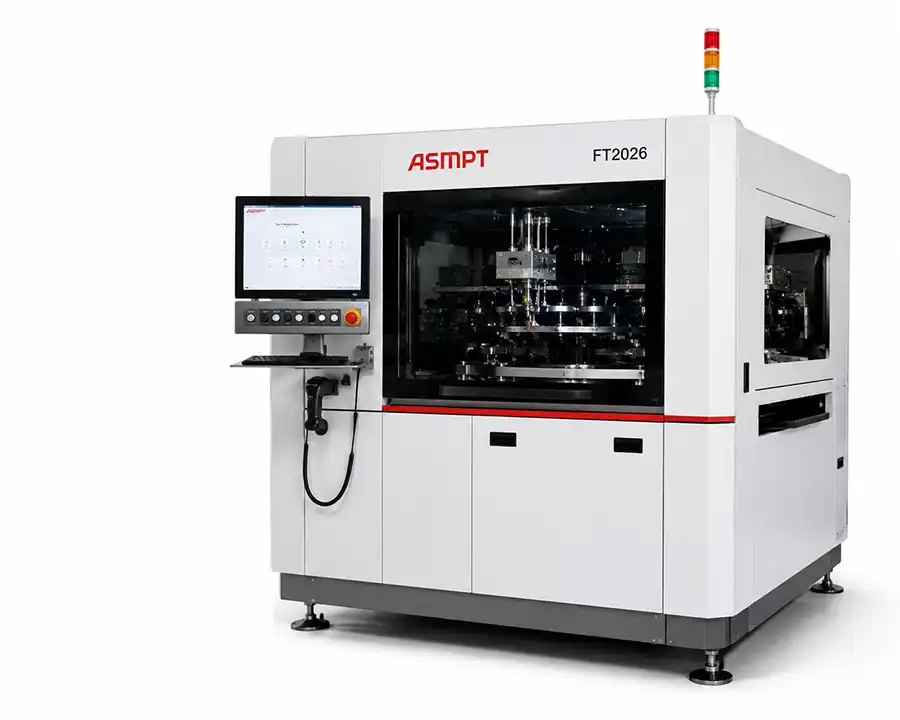
What Type of Machine Is the ASMPT FT2026?
The FT2026 belongs to ASMPT’s FT family of turret-based semiconductor test systems. It transports packaged devices around a rotary process path and presents them to the handling, testing, inspection and output stations installed on the machine.
It should not be confused with an SMT placement machine, wafer probing system, bare-die sorter or die bonder. Nor is it a complete semiconductor tester by itself. Electrical testing normally depends on a compatible external tester, suitable contact hardware and a working communication setup.
Legacy equipment may carry ASM branding, while current searches often use ASMPT FT2026. For a specific machine, the manufacturer and model shown on the nameplate remain the authoritative identity.
Verified ASMPT FT2026 Platform Information
| Platform Item | Official FT2026 Information | Machine-Specific Boundary |
|---|---|---|
| Equipment type | Fully automatic turret test system | The complete electrical-test process depends on the tester and installed interface |
| Device direction | Medium-to-large packaged devices | Actual compatibility still requires package, tooling and process verification |
| Published size direction | Greater than 2 × 2 mm² | No universal upper size limit is stated in the current public information |
| Turret configuration | 26 nozzles | Nozzle condition and package-conversion hardware must be inspected |
| Parallel test sites | Up to 16 | Installed, equipped and active sites must be confirmed |
| Machine dimensions | 1,850 × 1,750 × 2,170 mm | Facility access and utility requirements remain machine-specific |
| Vision | Six-sided vision inspection | Installed cameras, software, recipes and calibration must be reviewed |
| Media handling | Vibratory bowl, tube, metal tray, JEDEC tray, tape and other supported configurations | An individual machine may contain only part of this module range |
The current public FT2026 information does not provide a universal devices-per-hour figure. Output should not be estimated from the nozzle count, test-site capacity, another FT model or third-party resale claims.
How the 26-Nozzle Turret Architecture Works
The FT2026 uses a direct-drive rotary turret with 26 nozzles. Official FT-series information also describes independent upper and lower drives supporting nozzle movement.
Input Module → Device Pickup → Orientation → Test-Site Presentation → Vision Inspection → Result-Based Sorting → Selected Output Module
This is a conceptual route rather than a fixed station layout. As the turret indexes, different positions may support pickup, orientation, electrical-test presentation, visual inspection and output operations. Several stages can therefore work around one controlled device path.
The exact sequence depends on the installed machine. The model name does not establish its station assignments, operating test-site count, index time, nozzle stroke or complete process cycle.
The Handler and Semiconductor Tester Perform Different Jobs
The FT2026 controls physical device handling. It receives packages through the installed input module, positions them at the test interface, supports inspection and routes them to the selected output according to the process result.
The semiconductor tester or ATE generates electrical stimulus, measures device response and produces the classification result. The DUT board, socket or contactor, docking hardware and site wiring form the mechanical and electrical connection between the package, handler and tester.
Buying an FT2026 therefore does not create a complete electrical-test solution on its own. The tester model, interface hardware, active site count, contact geometry, communication, software and package tooling must work together. Buyers reviewing the wider equipment architecture may also compare suitable semiconductor test handler machines.
Package Compatibility and the Greater-Than-2 × 2 mm² Direction
ASMPT positions the FT2026 for medium-to-large devices and publishes a size direction greater than 2 × 2 mm². The current public information does not provide a universal upper package-size limit.
Official application examples include BGA, SOIC, TSSOP, MSOP, QFN, DFN and WLCSP packages, together with magnetic, optical and distance sensors. These examples indicate intended application areas rather than guaranteed compatibility with every package variant.
Packages within the same family can differ in body dimensions, thickness, weight, lead pitch, ball layout, warpage, surface condition and orientation features. Optical windows, magnetic sensitivity and restricted pickup areas may introduce further handling requirements.
The package drawing should be compared with the installed nozzle, nest, socket or contactor, test-contact surface, input tooling, vision recipe and output module. A device that fits the general size direction may still require significant conversion work.
Input and Output Modules May Define the Real Application
Multiple-media handling is one of the FT2026 platform’s important characteristics. ASMPT lists vibratory bowls, tubes, metal trays, JEDEC trays and tape among the supported directions.
That does not mean every used machine includes all of these modules or can switch between them without conversion. One FT2026 may use tube input and tape-and-reel output, while another may be arranged around trays, a bowl feeder or a different sorting route.
On the input side, review the installed feeder or loader, tray or tube dimensions, track tooling, orientation method, sensors, jam detection and required change parts. The output review should cover the good-device route, reject and rework paths, carrier format, counting, traceability and packaging requirements.
For many projects, the installed media path has a greater influence on suitability than the FT2026 model name alone.
Up to 16 Test Sites and Real Production Capacity
ASMPT states that the FT2026 platform supports up to 16 parallel test sites. This is a platform maximum, not the operating configuration of every machine.
A buyer should distinguish between physical test positions, equipped sites, active sites, tester-supported sites and sites that are effective in the intended production process. Available station space does not prove that the required sockets, contactors, DUT hardware, wiring and tester channels are present.
The review should identify the installed site count, docking interface, tester channel capacity, site calibration, result mapping, retest logic and any bypassed positions.
More sites do not automatically produce more usable output. Test duration, device presentation, contact settling, tester capacity, inspection, retest logic and the selected output route all influence the complete cycle.
Because ASMPT does not publish one universal FT2026 UPH figure in the current public information, a meaningful capacity estimate must use the actual package, active site count, tester, inspection sequence and media path.
Six-Sided Vision and Optional iTechnologies
ASMPT lists six-sided vision inspection for the FT2026 platform. Its general role is to evaluate device surfaces, orientation, package presentation and visible conditions according to the configured inspection criteria.
For an available unit, review the installed cameras, lenses, lighting, inspection stations, software licenses, recipes, calibration state and recognition results using a relevant package. A live camera image alone does not establish that the complete inspection sequence is operational.
ASMPT also lists iTechnologies as optional. iContact is described as an optional technology that provides test-force control for very thin products.
The hardware, software activation, calibration and package compatibility of iContact or any other optional function must be established from the machine record and operating evidence. Camera performance, inspection accuracy and force values should not be inferred without approved documentation.
Tape-and-Reel and Result-Based Output
Official FT2026 information includes automatic tape replenishment, while post-seal inspection and automatic reel changing are listed as optional functions.
For an installed tape-and-reel path, review the carrier-tape width, pocket dimensions, cover tape, sealing module, seal condition, reel dimensions, tape tension, empty-reel handling, counting and labelling requirements.
The machine must also route good, rejected and rework devices according to the agreed sorting logic. Post-seal inspection and automatic reel changing should only be included in the project plan when their hardware and software are installed and demonstrated.
What to Check on a Used ASM FT2026
| Review Area | What to Confirm |
|---|---|
| Machine identity | Nameplate, exact model, serial number, manufacturing information, previous application and current status |
| Turret and nozzles | Indexing, nozzle count and condition, vertical movement, vacuum response, drives, noise and missing tooling |
| Input and output modules | Installed bowl, tube, tray or tape paths, orientation hardware, change parts, sensors and routing |
| Test sites | Installed and active sites, tester interface, DUT hardware, sockets, contactors, calibration and communication |
| Vision | Cameras, lighting, software, recipes, calibration, recognition and demonstrated inspection sequence |
| Software and records | Boot condition, user access, licenses, package programs, site mapping, backups, alarms, manuals and maintenance history |
| Delivery scope | Tooling, conversion kits, interfaces, spare parts, inspection, refurbishment and support actually included |
The inspection should establish what is installed, what operates, what evidence exists and what will be supplied. Exterior appearance and power-on status provide only part of that answer.
FAT Evidence Should Match the Package, Tester and Media Route
A practical factory acceptance test may begin with software boot, emergency-stop and interlock checks, turret homing, repeated indexing, nozzle movement and vacuum pickup and release.
Process-relevant evidence should then follow the installed route. Depending on the agreed scope, this may include input-module operation, device orientation, test-site presentation, tester communication, multi-site operation, vision recognition, sorting, reject routing and the configured tray or tape output.
Where practical, the trial should use the target or a representative package, the correct input medium, suitable nozzles and conversion parts, the required socket or contactor, the intended tester, representative test timing and the planned output route.
A dry-cycle video shows that parts of the machine move, but it does not establish package compatibility, tester integration, contact quality, inspection performance or production readiness. The achievable FAT scope depends on available tooling, software, tester access, samples and seller capability.
Confirm Conversion and Delivery Scope Before Quotation
The offer should clearly separate the current machine configuration from the conversion and support work required for the buyer’s process.
Confirm whether the quotation includes the input and output modules, installed test sites, docking interface, DUT board, sockets or contactors, nozzles, package tooling, vision options, tape-and-reel hardware, programs, backups, manuals and spare parts.
Inspection, calibration, product conversion, refurbishment, export preparation, installation, training and destination support should be listed separately. A platform feature shown in official material should not be treated as part of the sales scope unless it is present on the actual machine.
When the FT2026 May Be a Suitable Direction
The FT2026 deserves further evaluation when the project involves medium-to-large packaged devices, the required input and output media can be supported and the tester interface can accommodate the necessary test sites.
The available unit should also have suitable package tooling, sockets or contactors, vision functions and sorting routes. Conversion requirements must be practical, and FAT evidence should demonstrate the process stages that matter most to the project.
Another equipment direction may be needed when the package is outside the documented or demonstrated range, required media modules are unavailable, tester integration cannot be completed or necessary contact, vision or thermal functions are missing.
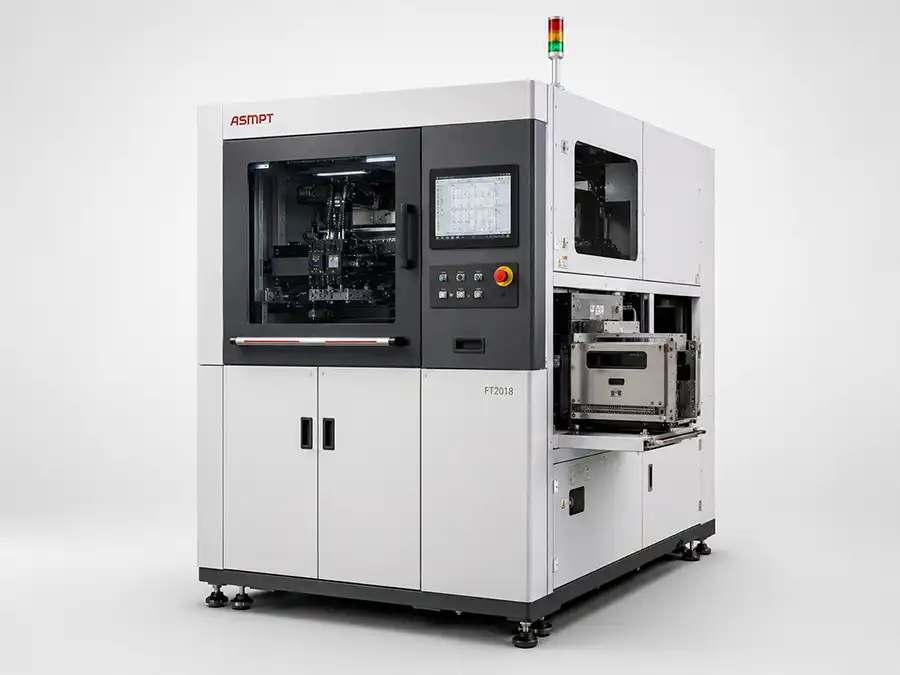
For smaller packaged devices, buyers may separately review the ASMPT FT2018 test handler. The final choice should still follow the package, tester, handling and output requirements rather than model size alone.
Check the Exact Configuration of an Available ASMPT FT2026
Before requesting a machine recommendation, prepare the package family, dimensions, thickness, input media, expected test duration, required parallel-site count, tester model, test-head interface, socket or contactor requirements, vision criteria, sorting logic, output media, tape-and-reel requirements, existing tooling, FAT scope and delivery destination.
Contact All-SMT through WhatsApp or email to request information about available ASMPT FT2026 equipment, including current machine photographs, nameplate details, installed input and output modules, test-site configuration, tester interface, package tooling, vision functions, operating evidence and delivery scope.
Package drawings, tooling images and process documents can be shared after the conversation is opened. Availability, package compatibility, active site count, refurbishment, price, delivery timing and FAT scope should be confirmed only after reviewing the actual machine.
Frequently Asked Questions About the ASMPT FT2026
What type of machine is the ASMPT FT2026?
It is a fully automatic 26-nozzle turret test system positioned by ASMPT for medium-to-large packaged semiconductor devices.
How many test sites does the FT2026 support?
The platform supports up to 16 parallel test sites. The number physically installed, equipped, calibrated and active on a specific machine must be confirmed.
What package sizes can the FT2026 handle?
ASMPT publishes a device-size direction greater than 2 × 2 mm² but does not state a universal upper limit in the current public information. Compatibility depends on package dimensions, thickness, tooling, contact hardware, vision and media handling.
What input and output methods can the FT2026 support?
ASMPT lists vibratory bowls, tubes, metal trays, JEDEC trays and tape among the platform directions. An individual machine may contain only a subset of these modules.
Does ASMPT publish an FT2026 UPH figure?
The current public FT2026 information does not provide one universal UPH figure. Output should be evaluated from the package, test duration, active sites, tester, inspection sequence, media route and actual machine condition.
Is the FT2026 a semiconductor tester?
No. It is a turret test-handler system. Electrical testing normally depends on a compatible external tester, DUT hardware, sockets or contactors, interface hardware and communication software.
Conclusion: The ASMPT FT2026 is a fully automatic 26-nozzle turret test platform positioned for medium-to-large packaged devices, with a published size direction greater than 2 × 2 mm², up to 16 parallel test sites, six-sided vision and several possible media-handling routes. These capabilities describe the platform rather than the installed configuration of every machine, and no universal FT2026 UPH figure should be invented. Buyers should verify package tooling, tester interfaces, active sites, vision, input and output modules, condition and process-relevant FAT evidence before requesting or accepting a quotation.