 EN
EN id
id sk
sk sr
sr sv
sv it
it pt
pt bn
bn ms
ms be
be nl
nl fr
fr th
th vi
vi ru
ru ja
ja ko
ko de
de hy
hy az
az bs
bs bg
bg my
my cs
cs da
da dv
dv el
el et
et fil
fil fi
fi ga
ga gl
gl gn
gn he
he hi
hi km
km hr
hr hu
hu is
is kn
kn rw
rw lo
lo lv
lv lt
lt lb
lb lg
lg mi
mi mt
mt ne
ne no
no ny
ny or
or om
om per
per pl
pl ro
ro sa
sa so
so es
es sw
sw ta
ta tr
tr uk
uk ur
ur cy
cy xh
xh
The ASMPT MS100, also commonly listed under the legacy ASM MS100 name, is generally identified in public used-equipment records as a wafer mapping die sorter or map sorter. Its role is to pick and route dies according to map information, the configured process and the handling hardware installed on the machine.
This model identity establishes the general equipment category, but the practical capability of a used MS100 must be determined from the individual unit. Pickup hardware, wafer or frame handling, vision, software, tooling, output configuration and previous application can vary between machines.
Accuracy note: A reliable universal MS100 specification set is not available from the current evidence. Throughput, accuracy, supported die or wafer formats, software functions and other machine-specific claims should be confirmed from the nameplate, original documentation, installed modules and operating evidence for the actual unit.
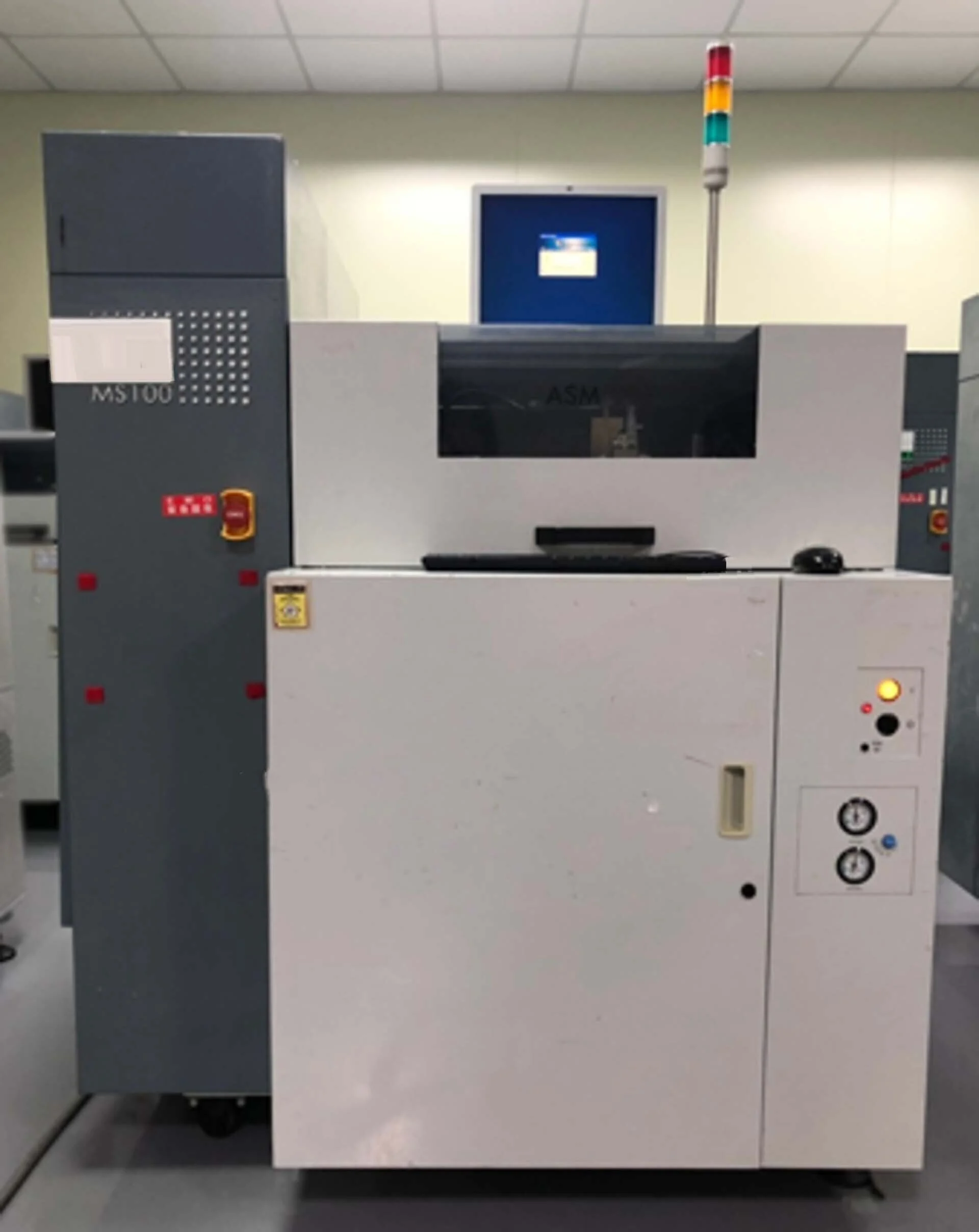
What Type of Machine Is the ASM MS100?
The ASM MS100 is most safely described as legacy ASM semiconductor equipment used for wafer-map-based die sorting. Older nameplates and records may use ASM, while current searches may use ASMPT MS100. The manufacturer identity shown on the machine itself should remain the reference for an individual unit.
In a typical sorting application, map or recipe information identifies the required die position and classification. The installed handling system then picks the die and routes it to an assigned carrier, frame, grade or output position. The exact sequence depends on the supplied hardware, software and process configuration.
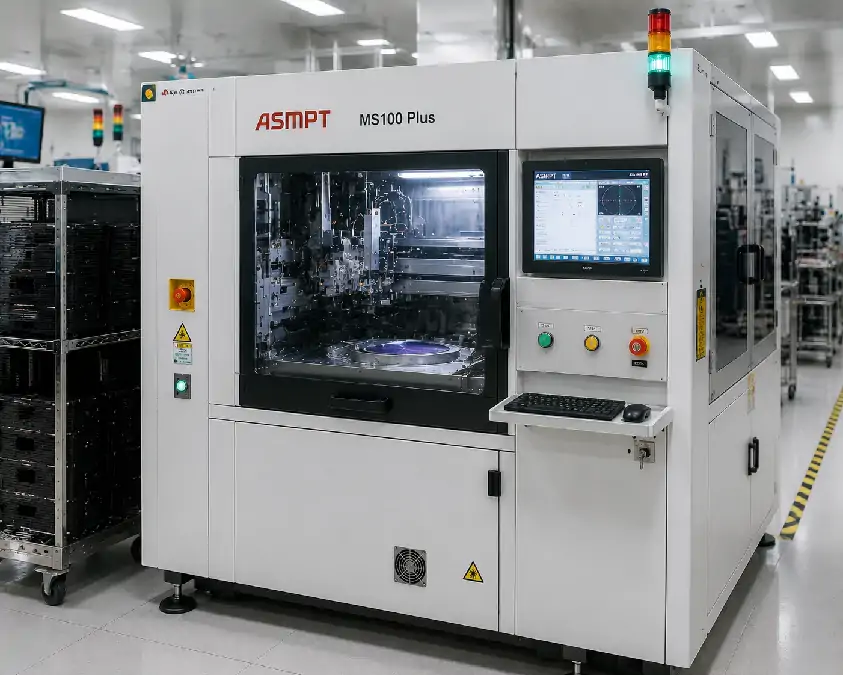
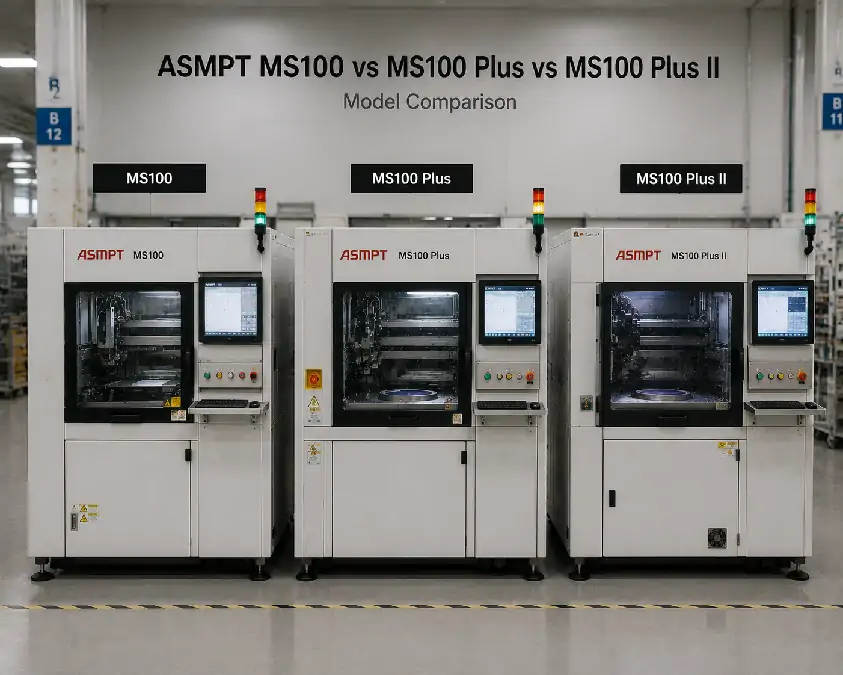
MS100, MS100 Plus, MS100 Plus II and MS90 should be treated as separate model targets. Specifications or capabilities published for an MS100 Plus must not be transferred to an MS100 unless original documentation confirms that they apply.
Wafer Map Sorters, Test Handlers and Die Bonders Have Different Roles
Semiconductor equipment terminology is not always used consistently in resale listings. Buyers should first identify the machine’s primary process responsibility.
| Equipment Role | Primary Function | Important Boundary |
|---|---|---|
| Wafer mapping die sorter | Uses map or recipe information to pick and route dies to assigned outputs | Classification data may originate from an earlier test or inspection process |
| Electrical test handler | Presents devices to compatible electrical test sites and ATE | Requires suitable contact hardware, tester communication and software |
| Die bonder | Places and attaches dies to a substrate, package or other target | The die is bonded rather than routed into sorting outputs |
An electrical test handler normally works with compatible test sites, sockets or contactors and automatic test equipment. A die bonder attaches a die to another surface through a bonding process. A wafer mapping die sorter instead uses process data to control die pickup and output routing.
The MS100 should therefore be evaluated primarily as a wafer mapping die sorter unless original machine documentation and the installed configuration establish another verified process capability.
How a Wafer-Map-Based Die-Sorting Route Generally Works
A general wafer-map sorting route may follow this sequence:
Present the supported wafer or film-frame format to the machine.
Load or select the relevant map and process recipe.
Locate the die position identified by the process data.
Pick the die using the installed pickup and ejector arrangement.
Align or inspect the die where the system is configured to do so.
Place the die into the assigned carrier, frame, grade or output location.
Update the process record and continue the sorting sequence.
This is a general process concept, not an exact mechanical description of every MS100. Alignment, inspection, output routing and record functions depend on the hardware and software supplied with the individual machine.
What the Wafer Map Does in the Sorting Process
A wafer map may contain die-location data, classification or grade information and process status used by the configured sorting workflow. The machine can use this information to determine which die should be selected and where it should be routed.
The classification data may come from an upstream electrical test or inspection process and then be used during downstream sorting. The presence of wafer-map handling therefore identifies a sorting workflow, not necessarily an electrical-testing function inside the MS100 itself.
Supported file formats, software interfaces, recipe structures and communication methods should be verified from the actual system. Generic resale descriptions are suitable for model identification but should not be treated as evidence of specific map or software capabilities.
Why the MS100 Model Name Is Not Enough
Two machines carrying the same MS100 model name may have different process capabilities. Differences may include the pickup head, ejector arrangement, collets or nozzles, wafer table, frame-handling system, cameras, lighting, output carriers and binning layout.
Software versions, recipes, licenses, calibration condition, conversion tooling and previous applications can further affect suitability. A machine configured for one die, wafer frame or output route may require different hardware and process preparation for another project.
This configuration dependence is common across semiconductor pick-and-place handlers. The platform name identifies the equipment family, while the installed modules and tooling determine how the system can be used.
Buyers should review the photographs, nameplate, installed hardware, software condition, tooling and delivery scope of the available ASMPT MS100 equipment before deciding whether it may fit the intended process.
Information Needed to Evaluate an MS100 for Your Process
A useful MS100 inquiry should describe the target process rather than only asking whether the model is available.
Target Die
Provide the die dimensions and thickness, material or device type, surface condition, required orientation and any fragile or restricted pickup areas. These factors influence the pickup tooling, ejector arrangement and handling method that may be required.
Input Media
Identify the wafer or film-frame format, frame dimensions, wafer condition, loading method and available map or recipe information. These requirements should be compared with the wafer table and frame-handling configuration installed on the machine.
Output Route
Explain whether sorted dies must move to a carrier, frame, tray, bin or grade position. Required orientation, reject handling and output grouping should also be defined.
Process Requirements
Describe the sorting logic, alignment or inspection needs, traceability requirement, production target and expected changeover frequency. These inputs establish what must be demonstrated during the equipment review.
Providing this information does not assume that the MS100 supports every listed format. It gives the supplier enough context to compare the project with the actual machine configuration.
What to Check on a Used ASM MS100
A used-machine review should establish what is installed, what operates and what will be included with delivery. Power-on status alone provides only a small part of that evidence.
| Review Area | What to Confirm |
|---|---|
| Machine identity | Nameplate, exact model, serial number, available manufacturing information and previous application |
| Mechanical condition | Motion, wafer table, pickup mechanism, ejector area, head, cables, pneumatics, guards and interlocks |
| Vision and alignment | Installed cameras, lighting, recognition condition, calibration status and available recipes |
| Software and map handling | Boot condition, software version, backups, map-loading function, licenses, passwords and manuals |
| Output and tooling | Output media, carrier or bin arrangement, conversion kits, collets, nozzles, fixtures and included spares |
| Operating evidence | Homing, axis movement, alarm status, map loading, pickup and placement, sample sorting and output routing |
A power-on video may confirm that the machine boots and that some systems respond. It does not establish compatibility with the buyer’s die, confirm complete tooling or demonstrate production readiness.
Operating evidence should reflect the intended use as closely as practical. A controlled pickup, placement and output-routing sequence using relevant tooling provides more useful information than a generic axis-movement demonstration.
Why a Target-Die Trial Provides Stronger Evidence
Where practical, a representative process trial provides stronger compatibility evidence than the model name, a resale description or a basic power-on video.
A useful trial may include the target or representative die, intended wafer or frame format, relevant tooling, a compatible map or recipe and the required output carrier. The result can show whether the installed pickup, alignment and routing configuration is appropriate for the project.
The available test scope depends on machine condition, tooling, sample material, software access, seller capability and project timing. Not every machine can be tested with the buyer’s actual production material.
Trial requirements should be agreed before the machine is described as suitable. When a complete process trial is not possible, the remaining compatibility risks should be identified clearly for later confirmation.
When the MS100 May Not Be the Right Starting Point
Another equipment direction may be required when the primary task is electrical testing with ATE, sockets or contactors rather than wafer-map-based die sorting.
The MS100 may also be unsuitable when the required wafer, frame, die or output format cannot be supported, map or software compatibility cannot be established, conversion hardware is unavailable or a necessary inspection or process station is not installed.
A later platform or a different handling architecture may be more appropriate in some cases, but the replacement direction should follow the die, input media, process and output requirements rather than the model name alone.
Check the Configuration of an Available ASM MS100
Prepare the following information before requesting an equipment review:
Die dimensions and thickness
Wafer or frame format
Map or recipe requirements
Pickup and alignment requirements
Intended output carrier or sorting route
Existing tooling
Production target
Destination and facility information
Required operating or inspection evidence
Contact us through WhatsApp to review the available ASM MS100 machine configuration, including current photographs, nameplate information, installed hardware, available operating evidence, included tooling, inspection status and delivery scope.
The response should be based on the specific machine. Compatibility, price, delivery timing, refurbishment status and expected performance should be confirmed only after the available unit and project requirements have been reviewed.
Frequently Asked Questions About the ASMPT MS100
What type of machine is the ASM MS100?
Public used-equipment records commonly identify it as a wafer mapping die sorter, map sorter or device mapper sorter. The capability of an individual unit depends on its installed hardware, software and tooling.
Is the ASM MS100 an electrical test handler?
Not automatically. Electrical testing requires compatible test sites, contact hardware, tester communication and software. Wafer-map-based sorting can use classification data without performing the upstream electrical test itself.
Does the MS100 perform wafer mapping?
The platform is commonly described as a wafer mapping die sorter. The supported map formats, software workflow and data interfaces must still be checked from the actual machine and its documentation.
Which wafer and die sizes can the MS100 handle?
A universal range should not be applied to every machine. Compatibility depends on the installed wafer table, frame handling, ejector, pickup tools, vision system, software and conversion hardware.
What should be checked before buying a used ASM MS100?
Check the machine identity, installed configuration, mechanical and vision condition, software access, map handling, tooling, output route, operating evidence and exact delivery scope.
Are the ASM MS100 and MS100 Plus the same machine?
No. They are separate model targets. Specifications or capabilities published for an MS100 Plus or MS100 Plus II should not be applied to an MS100 without original supporting documentation.
Conclusion: The ASMPT or ASM MS100 is commonly identified as a wafer mapping die sorter, but practical compatibility depends on the individual machine. Wafer-map sorting, electrical testing and die bonding are different process roles, while pickup hardware, vision, software, tooling and output configuration can vary between used units. Buyers should request the exact machine record, review relevant operating evidence and use a representative process trial where practical before confirming suitability or requesting a final quotation.