 EN
EN id
id sk
sk sr
sr sv
sv it
it pt
pt bn
bn ms
ms be
be nl
nl fr
fr th
th vi
vi ru
ru ja
ja ko
ko de
de hy
hy az
az bs
bs bg
bg my
my cs
cs da
da dv
dv el
el et
et fil
fil fi
fi ga
ga gl
gl gn
gn he
he hi
hi km
km hr
hr hu
hu is
is kn
kn rw
rw lo
lo lv
lv lt
lt lb
lb lg
lg mi
mi mt
mt ne
ne no
no ny
ny or
or om
om per
per pl
pl ro
ro sa
sa so
so es
es sw
sw ta
ta tr
tr uk
uk ur
ur cy
cy xh
xh
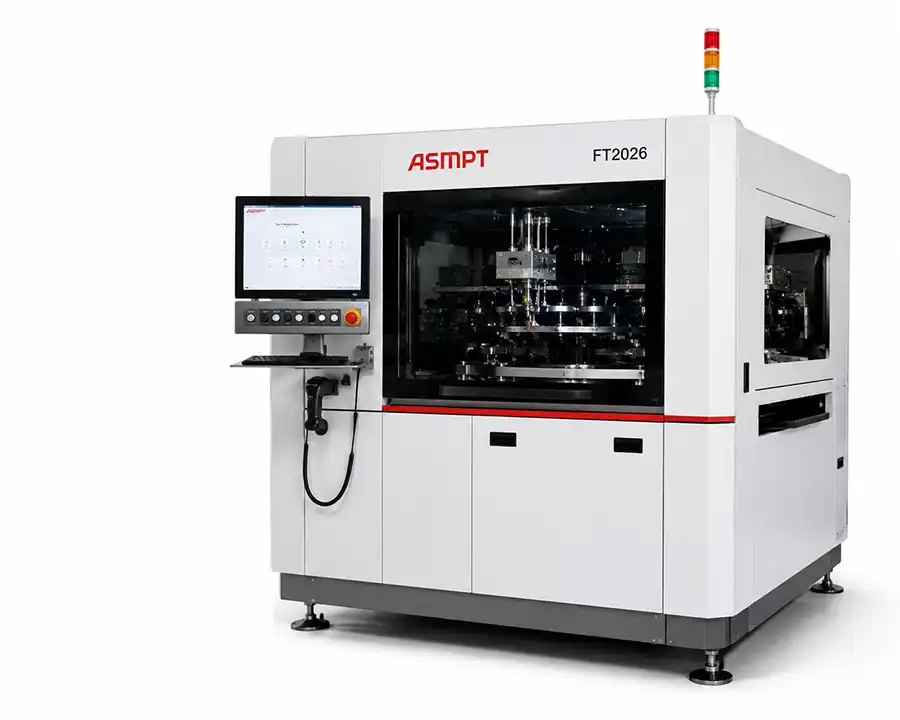
The ASMPT FT2018, also searched as the ASM FT2018, is a fully automatic turret test system for small packaged semiconductor devices. Its 18-nozzle rotary turret moves devices through configured pickup, orientation, test presentation, inspection, sorting and output stages.
ASMPT publishes a clear platform range for the FT2018, but those figures do not describe the ready-to-run configuration of every new, used or refurbished machine. The installed test sites, tester interface, package tooling, vision functions, software and output modules determine what an individual unit can actually support.
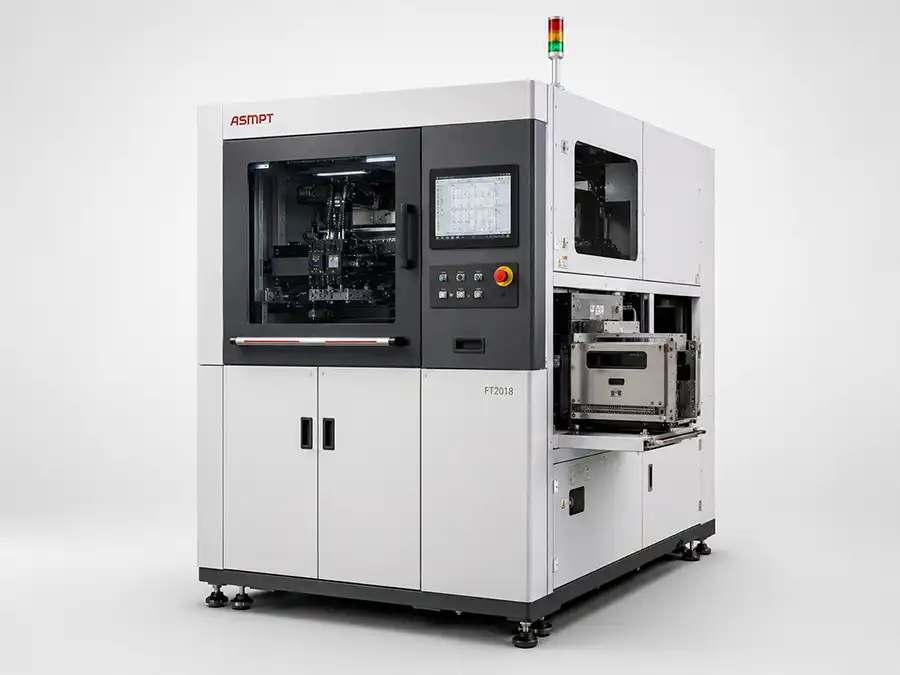
What Type of Machine Is the ASMPT FT2018?
The FT2018 belongs to ASMPT’s FT family of fully automatic turret test systems. It is designed to transfer small packaged semiconductor devices through a rotary process in which different positions can be assigned to handling, test presentation, visual inspection, result-based sorting and output.
It is a test-handler platform rather than a standalone semiconductor tester. The handler moves and positions the device, while compatible external test equipment normally generates the electrical stimulus, measures the response and returns the result used for classification.
Legacy equipment may carry ASM branding, while current searches often use ASMPT FT2018. For a specific machine, the manufacturer and model shown on the nameplate should remain the primary identification reference.
Verified ASMPT FT2018 Platform Specifications
| Platform Item | Official FT2018 Information | Buying Boundary |
|---|---|---|
| Equipment type | Fully automatic turret test system | The complete test process depends on the connected tester and installed interface |
| Machine dimensions | 1,620 × 1,260 × 2,170 mm | Facility access and utility requirements still need unit-specific confirmation |
| Turret configuration | 18 nozzles | Nozzle condition and package tooling must be inspected |
| Device range | 1 × 1 to 6 × 6 mm² | Dimensions alone do not establish package compatibility |
| Parallel test sites | Up to 8 | The installed, equipped and active site count must be confirmed |
| Throughput | Up to 50,000+ devices per hour at 30 ms test time | Actual output depends on the complete test and handling cycle |
| Vision | Six-sided vision inspection | Installed hardware, software, recipes and calibration must be reviewed |
| Listed applications | BGA, SOT, SOD, SC, DFN, QFN, SMA, WLCSP and selected magnetic and optical sensors | Each package still requires suitable tooling and test hardware |
These figures describe the published platform. They do not prove that a particular FT2018 has eight operational test sites, every optional inspection function or the correct conversion hardware for the buyer’s package.
How the 18-Nozzle Turret Process Works
The FT2018 uses an 18-nozzle rotary turret. ASMPT describes the FT architecture as using a direct-drive rotary turret with independent upper and lower drives supporting nozzle movement.
Input → Device Pickup → Orientation → Test-Site Presentation → Vision Inspection → Result-Based Sorting → Output or Tape-and-Reel
This route is conceptual rather than a fixed station map. Devices enter through the installed presentation system, are collected by suitable nozzles and move around the turret. At assigned positions, they may be oriented, presented to one or more test sites, visually inspected and routed according to the result. The actual sequence depends on the supplied input method, contact hardware, inspection stations and output configuration.
The Handler and Semiconductor Tester Perform Different Jobs
The FT2018 controls physical handling. It loads devices, moves them through the turret, presents them to the contact interface and directs them to the required output after testing or inspection.
A semiconductor tester or ATE produces electrical stimulus, measures device response and returns the test result. The socket, contactor, DUT board and docking interface create the physical and electrical connection between the package, handler and tester.
A complete electrical-test solution therefore requires more than the FT2018 itself. The handler, tester, test head, DUT hardware, contact components, communication setup, software and package tooling must work together. Buyers reviewing the wider architecture may also compare suitable semiconductor test handler machines.
Package Compatibility Requires More Than Device Dimensions
ASMPT publishes a device range of 1 × 1 to 6 × 6 mm² and lists BGA, SOT, SOD, SC, DFN, QFN, SMA and WLCSP packages, together with selected magnetic and optical sensors.
This range is useful for initial screening, but a package inside those dimensions is not automatically ready to run on every machine. Thickness, lead or pad layout, surface condition, warpage, fragile areas, pickup position, orientation and test-contact surface can all change the required configuration.
The actual unit must also include or support the correct nozzles, nests, package guides, input tooling, sockets or contactors, vision recipes and output hardware. Package drawings, tooling records and a representative trial provide a stronger compatibility basis than nominal dimensions alone.
Parallel Test Sites and Actual Throughput
The FT2018 platform supports up to eight parallel test sites. That is a platform limit, not evidence that every machine has eight installed and active sites. An equipment review should identify the physical site count, test-head arrangement, tester connection, DUT hardware, sockets or contactors, calibration status and communication with the external tester.
ASMPT publishes a handling rate of up to 50,000+ devices per hour at 30 ms test time. The test-time condition is essential because the complete cycle includes contact and settling time, vision, retest logic, sorting, reject handling, tape sealing and output-media changes.
Actual production output also depends on active site count, package conversion, machine condition and the required inspection and output sequence. Customer-specific throughput should be evaluated using the real package, test program and configured process rather than the platform maximum alone.
Six-Sided Vision and Optional iTechnologies
ASMPT lists six-sided vision inspection for the FT2018 platform. Its general role is to check device surfaces, orientation and package presentation according to configured criteria.
For an individual machine, review the installed cameras, optics, lighting, inspection stations, software licenses, recipes, calibration records and sample-recognition results. A live camera image does not by itself demonstrate complete six-sided inspection capability.
ASMPT also presents iTechnologies as optional functions. iAlign is intended to help reduce setup- or maintenance-related downtime, while iContact provides test-force control for very thin products. Their hardware, software activation, calibration and operating condition should be verified rather than assumed.
Tape-and-Reel and Output Configuration
ASMPT lists automatic tape-and-reel replenishment for the FT2018, together with optional post-seal inspection and automatic reel changing. These functions can support continuous packaging, but the exact supplied module still matters.
Review the carrier-tape width, pocket dimensions, cover tape, sealing module, temperature control, reel dimensions, empty-reel handling, reject route, counting and traceability requirements. Where automatic reel changing or post-seal inspection is required, confirm that the related hardware and software are installed, operational and included in the offer.
A machine may handle and test the package correctly but remain unsuitable if its tape format, reel handling, sorting route or traceability functions do not match production.
What to Check on a Used ASM FT2018
| Review Area | What to Confirm |
|---|---|
| Machine identity | Nameplate, exact model, serial number, manufacturing information, previous application and current status |
| Turret and nozzles | Turret indexing, nozzle movement, wear, vacuum response, drive condition, noise and missing tooling |
| Input and orientation | Installed input media, presentation hardware, guides, sensors, orientation system and change parts |
| Test sites | Installed and active site count, tester interface, DUT hardware, sockets, contactors and communication |
| Vision | Cameras, lighting, recipes, calibration, recognition results and installed inspection functions |
| Output | Sorting routes, tape path, sealing condition, reel functions, reject handling and traceability |
| Software and records | Boot status, access, package programs, backups, calibration records, alarms, manuals and maintenance history |
The review should establish what is installed, what operates, which records are available and what will be delivered. Exterior condition or a successful software boot cannot answer those questions by itself.
FAT and Target-Device Evidence
A useful FT2018 factory acceptance test should go beyond a basic dry cycle. Depending on the installed configuration and agreed scope, it may cover software boot, emergency-stop and interlock response, turret homing, repeated indexing, nozzle movement, vacuum response, device pickup, test-site presentation, tester communication, vision recognition, sorting, reject routing, tape-and-reel output and repeated cycles.
Where practical, the strongest evaluation uses the target or a representative package with the correct nozzle, conversion tooling, socket or contactor, compatible tester, intended site count, vision criteria and output media. This can reveal contact, recognition or conversion issues that are not visible in the platform specification table.
Not every seller can perform a complete electrical production trial. The available FAT scope depends on machine condition, tooling, tester access, sample devices, programs, recipes and seller capability. Any limits should be documented so the remaining technical risk is clear before purchase.
Conversion, Delivery Scope and Machine Suitability
The quotation should separate the existing machine configuration from the additional equipment and work required for the buyer’s process. Confirm whether the offer includes input modules, installed test sites, tester interface, DUT board, sockets or contactors, nozzles, conversion kits, vision options, tape-and-reel modules, programs, backups, manuals and spare parts.
Inspection, calibration, product conversion, refurbishment, export preparation, installation, training and destination support should be listed separately. These items should not be assumed to be included simply because they are needed for production.
The FT2018 deserves further evaluation when the package falls within the published range, suitable tooling can be supplied, tester integration can be confirmed and the available test sites, inspection functions and output modules fit the process. Another equipment direction may be more appropriate when those conditions cannot be met or the required conversion work is impractical.
Check the Exact Configuration of an Available ASMPT FT2018
Before requesting an equipment review, prepare the package type and dimensions, thickness, surface sensitivity, test duration, required parallel-site count, tester model, test-head or contact requirements, input media, vision criteria, sorting logic, output media, tape-and-reel specifications, existing tooling, FAT requirements and delivery destination.
Contact All-SMT through WhatsApp or email to request information for available ASMPT FT2018 equipment, including actual photographs, nameplate details, installed options, active test-site information, tester interface, package tooling, operating evidence, inspection or refurbishment scope and delivery details.
Package drawings, tooling photographs and process documents can be shared after the conversation is opened. Availability, compatibility, throughput, refurbishment, price and delivery timing should then be confirmed from the actual machine and project requirements.
Frequently Asked Questions About the ASMPT FT2018
What type of machine is the ASMPT FT2018?
It is a fully automatic turret test system designed to handle, present, inspect, sort and output small packaged semiconductor devices according to the installed machine and tester configuration.
What device sizes does the FT2018 support?
ASMPT publishes a platform range of 1 × 1 to 6 × 6 mm². Actual compatibility also depends on package thickness, nozzles, conversion tooling, sockets or contactors, vision recipes and output configuration.
Does the FT2018 always achieve 50,000 UPH?
No. ASMPT specifies up to 50,000+ devices per hour at 30 ms test time. Actual output depends on test duration, active sites, inspection, sorting, output handling, package setup and machine condition.
Does every FT2018 have eight test sites?
No. The platform supports up to eight parallel test sites, but the number installed, equipped and active on an individual machine must be confirmed.
Is the FT2018 a semiconductor tester?
It is a turret test-handler system. Electrical testing normally depends on a compatible external tester, test interface, DUT hardware, sockets or contactors and communication software.
Are iAlign and iContact standard on every FT2018?
No. ASMPT lists these iTechnologies as optional functions. Their installation, software activation, calibration and operating condition must be checked on the specific machine.
Conclusion: The ASMPT FT2018 is an officially documented 18-nozzle turret test platform for small packaged semiconductor devices, with a published range of 1 × 1 to 6 × 6 mm², up to eight parallel test sites, six-sided vision and a rated output of up to 50,000+ devices per hour at 30 ms test time. These figures describe the platform rather than every available unit. Buyers should verify the package tooling, tester interface, active test sites, vision functions, output modules and optional technologies, then request process-relevant FAT evidence and a clearly defined delivery scope before accepting a quotation.