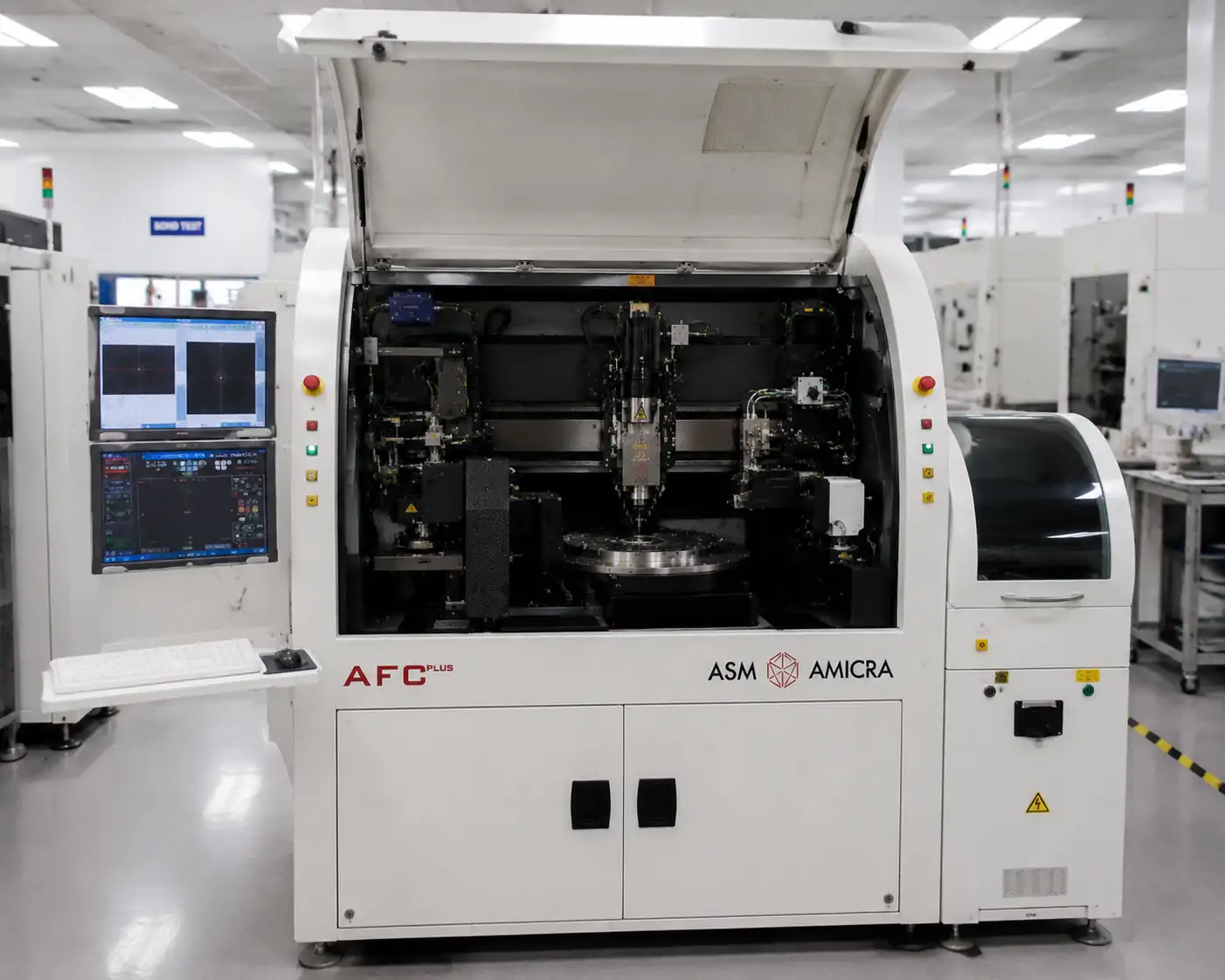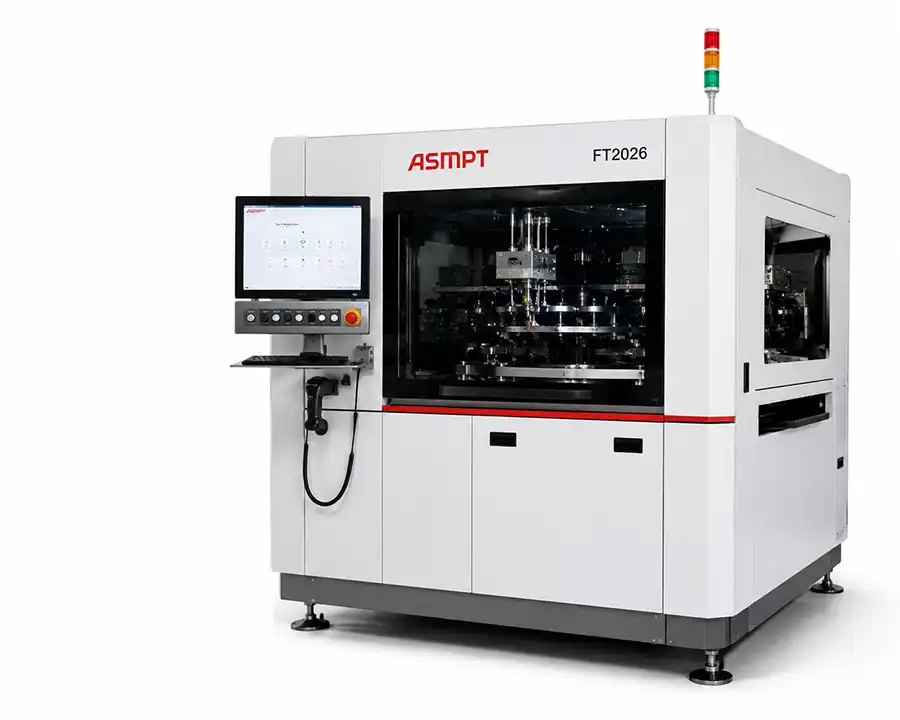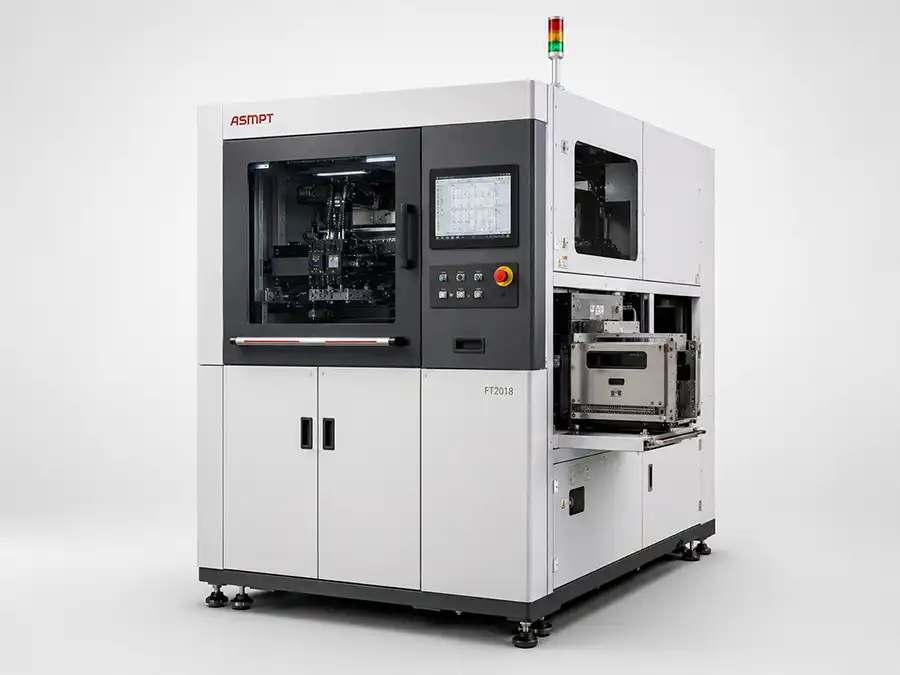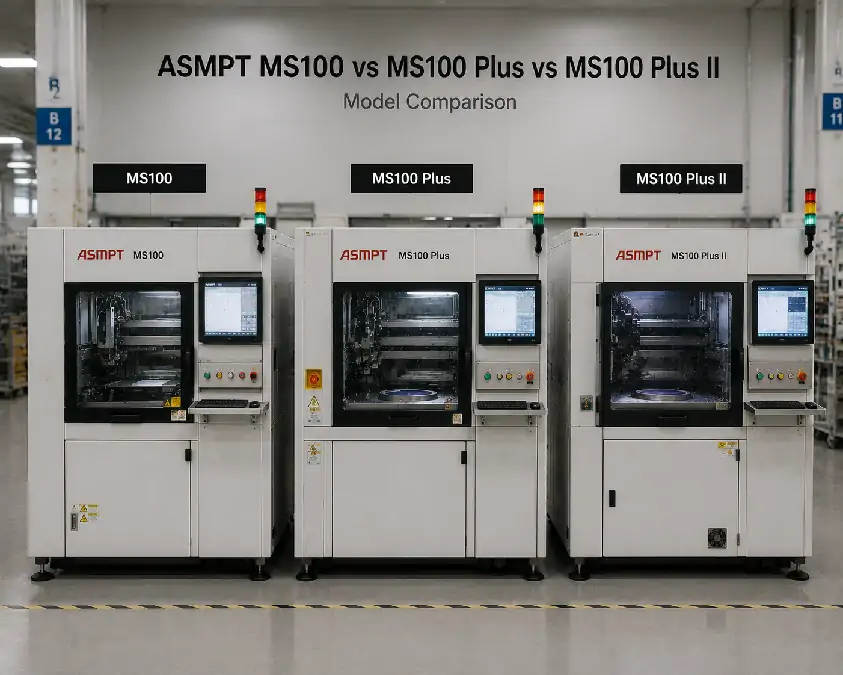
In semiconductor manufacturing, selecting the right automated handling solution is a critical decision that can directly affect production efficiency, testing consistency, equipment utilization, and long-term manufacturing performance. The ASMPT Test Handler is designed for semiconductor production environments where manufacturers require automated device handling, accurate positioning, stable process control, and integration with high-volume testing workflows.
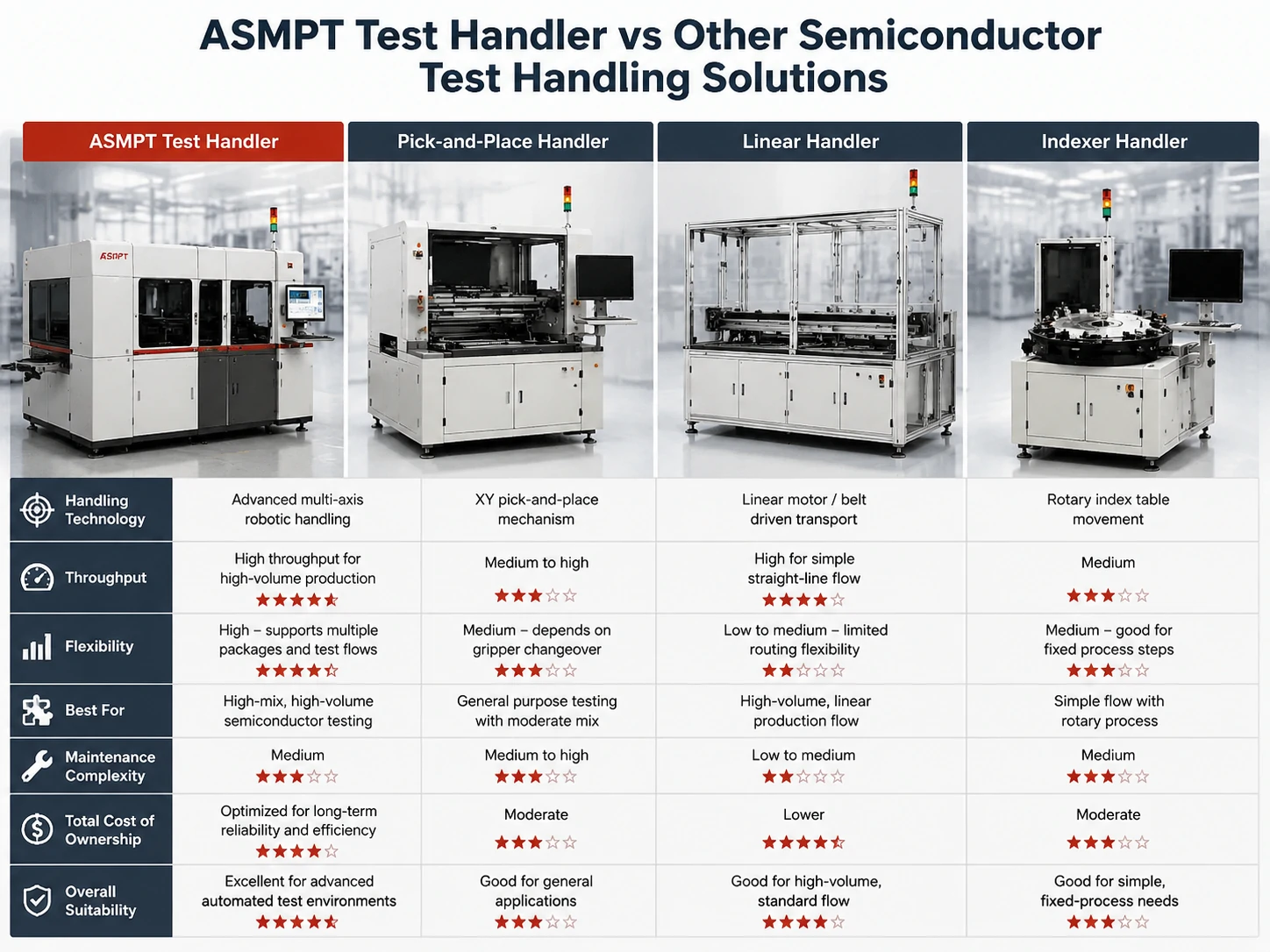
However, ASMPT Test Handler is only one option among various semiconductor test handling solutions available in the industry. Different handler technologies are designed for different production requirements, device packages, testing conditions, and manufacturing strategies. Understanding these differences helps engineers and procurement teams evaluate which solution best fits their operational goals.
This article provides an ASMPT Test Handler comparison based on technology architecture, performance evaluation factors, application suitability, and equipment selection considerations. Instead of focusing only on individual machine specifications, the comparison explains how semiconductor manufacturers should evaluate automated test handling solutions in real production environments.
What Is ASMPT Test Handler?
An ASMPT Test Handler is automated semiconductor handling equipment used to transport, position, organize, and manage semiconductor devices during testing processes. In modern semiconductor manufacturing, test handlers act as a connection point between device loading systems, semiconductor testers, sorting processes, and final output management.
The main purpose of a semiconductor test handler is to automate repetitive device movement while maintaining accurate positioning and consistent testing conditions. By reducing manual handling requirements, automated handlers help manufacturers improve production repeatability, reduce handling-related risks, and support continuous manufacturing operations.
For high-volume semiconductor production, a test handler is not simply a transportation system. It is an important part of the automated semiconductor testing system that influences throughput, process stability, equipment availability, and overall production efficiency.
Role of Test Handlers in Semiconductor Manufacturing
After semiconductor devices complete manufacturing and packaging processes, they must undergo electrical testing, functional verification, and quality inspection before shipment. During this stage, semiconductor test handlers manage the movement and positioning of devices throughout the testing workflow.
A typical semiconductor testing process involves several key operations:
Loading semiconductor devices into the handling system
Moving devices into accurate testing positions
Connecting devices with semiconductor testing equipment
Sorting tested devices according to results
Transferring finished devices to output locations
Without reliable handling automation, semiconductor testing operations can face problems such as inconsistent positioning, reduced production efficiency, increased operator involvement, and higher risk of device damage.
For manufacturers producing large quantities of semiconductor devices, handling performance becomes increasingly important because small variations repeated across thousands or millions of cycles can influence overall production results.
Key Functions of ASMPT Test Handler
When evaluating ASMPT Test Handler solutions, manufacturers usually focus on production-related capabilities rather than isolated machine features. The key functions include:
Automated device handling:Supports continuous movement and positioning of semiconductor devices during testing operations.
Testing workflow integration:Connects handling operations with semiconductor testers and factory automation systems.
Process consistency:Provides repeatable device movement and positioning to maintain stable testing conditions.
Production scalability:Supports manufacturing environments requiring reliable automated operation over extended production periods.
Device management:Helps organize device flow before, during, and after semiconductor testing.
The suitability of a test handler depends on how well these capabilities match production requirements, including device type, testing volume, package characteristics, and factory automation goals.
How Semiconductor Test Handlers Work
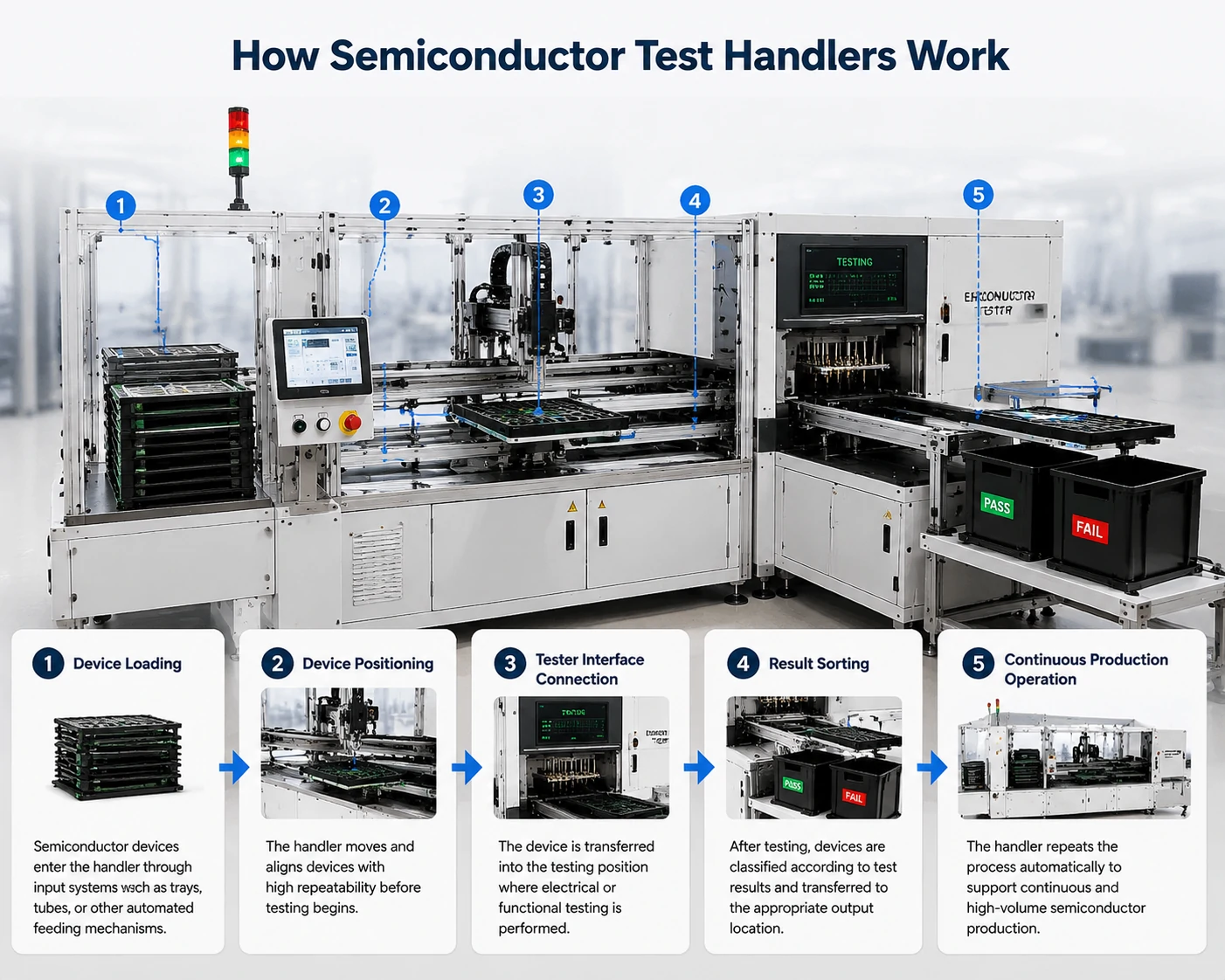
Although different handler technologies use different mechanical structures and control methods, most semiconductor test handlers follow a similar automated workflow.
Device Loading:Semiconductor devices enter the handler through input systems such as trays, tubes, or other automated feeding mechanisms.
Device Positioning:The handler moves and aligns devices with high repeatability before testing begins.
Tester Interface Connection:The device is transferred into the testing position where electrical or functional testing is performed.
Result Sorting:After testing, devices are classified according to test results and transferred to the appropriate output location.
Continuous Production Operation:The handler repeats the process automatically to maintain efficient semiconductor manufacturing workflows.
The performance of each stage can influence overall production efficiency. Factors such as positioning accuracy, movement stability, cycle time, and integration capability all contribute to the effectiveness of an automated test handler.
ASMPT Test Handler Technology Overview
The technology differences between semiconductor test handlers are mainly reflected in automation architecture, handling mechanisms, process control capability, and production scalability.
When comparing ASMPT Test Handler with other semiconductor handling equipment, manufacturers should evaluate how the system performs within their specific production environment rather than relying on a single specification or performance claim.
Automation and Material Handling Capability
Automation capability is one of the most important factors when evaluating semiconductor handling equipment. A modern handler must provide stable device movement, accurate positioning, and efficient integration with existing semiconductor testing systems.
Important automation considerations include:
Stable operation during repeated production cycles
Compatibility with semiconductor testers and factory systems
Efficient material flow management
Ability to support different production requirements
Reduction of manual intervention in testing workflows
ASMPT Test Handler solutions are typically evaluated in environments where manufacturers require automated production support, consistent handling performance, and reliable integration with semiconductor manufacturing processes.
Testing Accuracy and Process Stability
Semiconductor testing requires precise device positioning and consistent process conditions. Any variation during handling may influence test accuracy, production efficiency, and quality control results.
When comparing an ASMPT Test Handler with other semiconductor test handlers, engineers usually evaluate several technical factors that influence process stability:
Handling Precision:The ability of the system to accurately position semiconductor devices during testing operations.
Repeatability:The consistency of handling performance across repeated production cycles.
Mechanical Stability:The ability to maintain reliable movement and positioning during continuous operation.
Process Control:The capability to maintain stable testing conditions throughout production.
These factors become increasingly important when manufacturers produce advanced semiconductor devices where testing accuracy directly affects yield management and product quality.
Support for High-Volume Production
High-volume semiconductor manufacturing requires equipment that can operate continuously while maintaining stable performance. For this reason, production environments often evaluate test handlers based on throughput, reliability, automation capability, and long-term operational stability.
Important evaluation factors include:
Throughput:The number of semiconductor devices that can be processed within a specific production period.
Equipment Availability:The percentage of time the handler can operate reliably without unexpected interruptions.
Cycle Stability:The ability to maintain consistent performance during long production runs.
Integration Capability:The ability to work efficiently with testers and automated manufacturing systems.
For manufacturers operating large-scale semiconductor production lines, handler selection often focuses on balancing maximum output with process reliability.
Different Types of Semiconductor Test Handlers
The semiconductor industry uses different types of test handling solutions depending on device characteristics, production requirements, and testing environments. Understanding these differences helps manufacturers evaluate where ASMPT Test Handler solutions fit within the broader semiconductor handling equipment market.
Pick-and-Place Handlers
Pick-and-place handlers use mechanical systems to move semiconductor devices between different process positions. These systems are commonly evaluated for their flexibility, positioning accuracy, and ability to support different device packages.
They may be suitable for manufacturing environments where device compatibility and handling flexibility are important considerations.
Gravity Handlers
Gravity handlers use controlled device movement methods based on gravity-assisted feeding mechanisms. These solutions may be used for specific semiconductor testing applications where device characteristics and production requirements match this handling approach.
Their suitability depends on factors such as device type, testing requirements, and production workflow design.
Turret-Based Handlers
Turret-based handlers are designed for high-speed semiconductor testing environments where continuous rotary movement supports fast device transfer and high production throughput.
These systems are often considered when manufacturers prioritize production speed, cycle efficiency, and automated operation.
Specialized Package Handlers
Some semiconductor devices require specialized handling solutions due to package structure, testing conditions, or manufacturing requirements. These handlers may focus on specific applications rather than general-purpose production environments.
When selecting between different handler technologies, manufacturers should consider whether the solution matches current device requirements and future product development plans.
ASMPT Test Handler Compared With Other Handler Solutions
Comparing ASMPT Test Handler with other semiconductor test handling solutions requires evaluating multiple factors rather than focusing on a single specification.
Different handler technologies may provide advantages in areas such as automation level, throughput, flexibility, package compatibility, and maintenance requirements. The most suitable solution depends on the manufacturing environment and production objectives.
Technology Differences
The main technology differences between semiconductor test handlers include handling architecture, automation approach, integration capability, and flexibility.
| Comparison Dimension | ASMPT Test Handler Evaluation Focus | Other Handler Considerations |
|---|---|---|
| Automation Capability | Designed for automated semiconductor production workflows requiring consistent device handling. | Some solutions may focus more on specialized applications or flexible production requirements. |
| Handling Architecture | Evaluated based on device movement accuracy, process stability, and production integration. | Different mechanical designs may provide advantages for specific device types. |
| Integration Capability | Important for connecting handlers with testers and semiconductor manufacturing systems. | Integration levels vary depending on equipment design and factory requirements. |
| Production Flexibility | Suitable evaluation depends on device variety and manufacturing strategy. | Some solutions may prioritize quick changeover or specialized device support. |
Performance Differences
Performance comparison between semiconductor test handlers should focus on measurable production factors rather than general equipment descriptions.
Key performance evaluation criteria include:
Throughput (UPH):The number of units processed per hour and the ability to meet production targets.
Repeatability:The consistency of device handling and positioning across multiple cycles.
Test Parallelism:The ability to support multiple testing operations simultaneously.
Equipment Availability:The capability to maintain reliable operation and reduce production interruptions.
Maintenance Requirements:The impact of service activities on long-term production efficiency.
A high-volume semiconductor manufacturer may prioritize throughput and uptime, while another production environment may place greater importance on flexibility, package compatibility, or specialized testing requirements.
Application Differences
The best semiconductor test handler depends heavily on the application environment. Different manufacturers may have different priorities depending on product type, production scale, and testing complexity.
High-volume semiconductor production:Manufacturers usually prioritize automation, throughput, equipment stability, and continuous operation capability.
Multiple device package production:Manufacturers may require greater flexibility and compatibility with different semiconductor packages.
Specialized testing environments:Some applications may require specific handling capabilities based on device characteristics and testing conditions.
Future production expansion:Manufacturers should consider whether the selected handler can support future product changes and technology development.
How to Choose Between Different Semiconductor Test Handlers
Selecting the right semiconductor test handler requires balancing technical capability, production requirements, and long-term operational goals. A solution that performs well in one manufacturing environment may not necessarily be the best choice for another application.
Manufacturers evaluating an ASMPT Test Handler or other semiconductor handling solutions should consider several key decision factors before investing in equipment.
Production Volume Requirements
Production volume is one of the most important factors when selecting semiconductor test handling equipment. High-volume semiconductor manufacturing environments typically require solutions that can support continuous operation, stable throughput, and efficient automation.
For large-scale production, manufacturers should evaluate:
Required throughput and production capacity
Equipment availability and operational stability
Automation level and workflow integration
Ability to maintain consistent performance over extended production periods
An automated test handler designed for high-volume environments should help manufacturers maintain productivity while reducing risks caused by manual handling and process variation.
Device Type Compatibility
Different semiconductor devices and package structures may require different handling approaches. Compatibility between the handler, tester, and semiconductor products is essential for achieving reliable testing performance.
Manufacturers should evaluate:
Package types:Different packages such as QFN, BGA, CSP, LGA, and lead frame packages may require different handling considerations.
Device characteristics:Size, shape, thermal requirements, and mechanical sensitivity can influence handler selection.
Testing requirements:Electrical testing conditions and production workflows may affect equipment suitability.
Future product plans:The selected handler should support possible changes in product portfolio and manufacturing needs.
Maintenance and Long-Term Operation
Equipment selection should not only focus on initial performance. Long-term operational efficiency is also an important factor when comparing semiconductor test handlers.
Manufacturers should consider:
Maintenance frequency and complexity
Availability of technical support
Spare parts management
Potential production downtime impact
Expected equipment lifetime
Total Cost of Ownership Considerations
The total value of a semiconductor test handler depends on more than the initial equipment investment. Long-term operating costs can significantly influence manufacturing efficiency and return on investment.
Total Cost of Ownership (TCO) evaluation may include:
Equipment purchase cost
Maintenance requirements
Operator requirements
Downtime-related production losses
Technical service availability
Future upgrade possibilities
A handler with strong reliability and efficient maintenance processes may provide better long-term value even when different equipment options have similar initial capabilities.
Application-Based Semiconductor Test Handler Selection Examples
Different semiconductor manufacturing environments may prioritize different handler capabilities. The following examples illustrate how production requirements influence equipment selection decisions.
High-Volume IC Production
For manufacturers producing large quantities of integrated circuits, the main priorities are usually throughput, automation stability, and equipment availability.
In these environments, manufacturers typically evaluate:
High production efficiency
Stable automated operation
Consistent device handling performance
Integration with existing semiconductor testing systems
Flexible Manufacturing Environments
Manufacturers producing multiple device types may require more adaptable handling solutions. In these cases, flexibility and changeover capability become important evaluation factors.
Key considerations include:
Support for different device packages
Efficient production changeover
Reduced setup complexity
Compatibility with future product changes
Advanced Semiconductor Package Testing
Advanced semiconductor packages may introduce additional handling challenges due to package structure, testing requirements, and device sensitivity.
Manufacturers may need to evaluate:
Handling precision
Package compatibility
Testing environment requirements
Process control capability
Frequently Asked Questions
What is an ASMPT Test Handler used for?
An ASMPT Test Handler is used to automate semiconductor device handling during testing processes. It manages device transportation, positioning, workflow integration, and sorting operations within semiconductor manufacturing environments.
How does ASMPT Test Handler improve semiconductor testing?
ASMPT Test Handler can support semiconductor testing by improving handling consistency, automation efficiency, and production workflow stability. The actual benefits depend on equipment configuration, device requirements, and manufacturing conditions.
What are the main differences between semiconductor test handlers?
The main differences between semiconductor test handlers include handling architecture, automation technology, throughput capability, device compatibility, flexibility, maintenance requirements, and suitability for specific production applications.
How does ASMPT Test Handler compare with other semiconductor handlers?
ASMPT Test Handler comparison should consider factors such as automation capability, production requirements, handling performance, integration with testing systems, and application suitability. Different handler technologies may provide advantages depending on the manufacturing environment.
Which semiconductor test handler is best for high-volume production?
The best semiconductor test handler for high-volume production depends on production requirements, device types, testing conditions, and factory automation goals. Manufacturers should evaluate throughput, reliability, compatibility, and long-term operation requirements before selecting equipment.
Can one semiconductor test handler support different package types?
Support for different package types depends on the specific handler design and configuration. Manufacturers should evaluate package compatibility, handling requirements, and future product plans when selecting semiconductor handling equipment.
Conclusion
Choosing between ASMPT Test Handler and other semiconductor test handling solutions requires a comprehensive evaluation of technology, performance, application requirements, and long-term operational factors.
ASMPT Test Handler solutions can be evaluated based on their ability to support automated semiconductor manufacturing workflows, stable device handling, and high-volume production requirements. However, the most suitable handler depends on each manufacturer's production environment, device characteristics, testing requirements, and business objectives.
When comparing semiconductor test handlers, manufacturers should focus on practical factors such as throughput, repeatability, equipment availability, package compatibility, maintenance requirements, and total cost of ownership rather than relying on a single performance measurement.
A structured evaluation approach helps engineers and procurement teams select the semiconductor handling equipment that best supports current production needs and future manufacturing development.