
The used ASM AD830 Plus die bonder is a fully automatic high-speed die attach system designed to pick semiconductor dies from a wafer and bond them onto lead frames using a silver-epoxy process. The machine combines lead-frame transportation, wafer positioning, die recognition, epoxy application, die pickup, placement and optical inspection in one automated production platform.
This model may also appear in customer inquiries and equipment records as the ASM AD 830 PLUS, AD830PLUS, AD 830 Plus die bonder or ASM Pacific Technology AD830 Plus. Before purchasing a machine, the exact model, serial number, installed modules and tooling should be confirmed from the machine nameplate and physical configuration.
We support customers looking for an ASM AD830 Plus for production replacement, capacity expansion, spare-machine preparation or second-hand semiconductor equipment projects. Available units may differ in manufacturing year, software, epoxy module, wafer loader, lead-frame input system, tooling and overall condition.
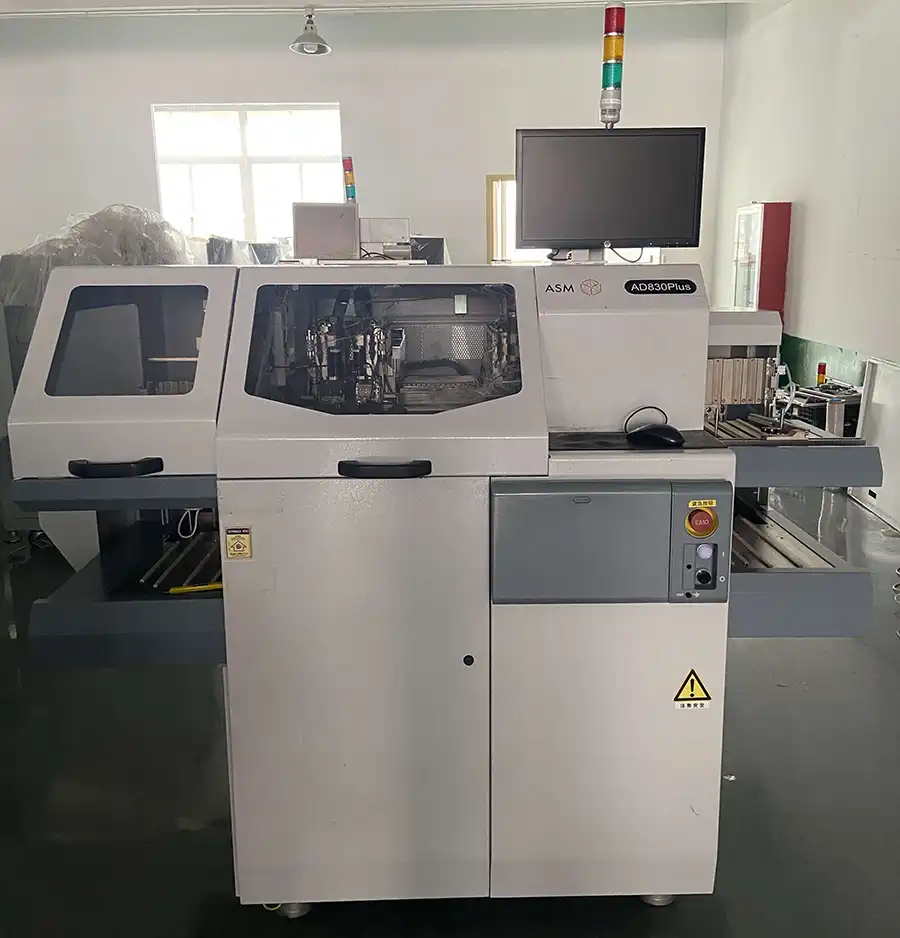
ASM AD830 Plus Availability Overview
| Brand | ASM / ASM Pacific Technology |
|---|---|
| Machine Model | AD830 Plus / AD830PLUS |
| Machine Category | Automatic Semiconductor Die Bonder |
| Primary Application | Wafer-to-lead-frame silver-epoxy die attach |
| Equipment Condition | Used, second-hand or serviced condition, subject to the available unit |
| Documented Cycle Time | 163 ms under specified operating conditions |
| Die Handling Range | 6 x 6 to 200 x 200 mil |
| Wafer Capacity | Up to 8-inch wafer handling |
| Lead-Frame Width | 12 to 102 mm |
| Lead-Frame Length | 110 to 300 mm; optional short-format configuration from 80 to 110 mm |
| Bond Head | Single X-Y-Z linear-motion bond-head assembly |
| Epoxy Process | Silver-epoxy dispensing or stamping, depending on configuration |
| Vision System | 480 x 480 pixel PR system with programmable LED illumination |
| Inspection Functions | Wafer PR, lead-frame PR, pre-bond inspection and post-bond inspection |
| Power Requirement | 110-240 VAC, single phase, 50/60 Hz |
| Compressed Air | Minimum 6 bar / 87 PSI |
| Power Consumption | Approximately 1,250 W |
| Shipping | Export packaging and international delivery support available |
All specifications, options and included accessories must be checked against the actual machine before order confirmation. Used machines with the same model name may have different production configurations.
Why Manufacturers Source a Used ASM AD830 Plus
A used ASM AD830 Plus may be considered when a production facility already operates the same machine platform, needs additional die bonding capacity or wants to replace an unavailable machine without redesigning the complete process.
Using the same machine family can simplify several production requirements:
Existing package files may be easier to transfer or recreate
Operators may already understand the machine interface
Existing collets, ejector tools and anvils may remain useful
Maintenance teams may already stock compatible components
Process-development time may be shorter than changing to a different platform
Production lines may retain similar material-handling arrangements
However, the machine should not be selected only because the model name matches an existing unit. Differences in wafer loader, epoxy module, lead-frame input, software, optics and tooling can affect compatibility with the intended product.
How the AD830 Plus Production Cycle Works
The AD830 Plus is designed to receive lead frames, apply silver epoxy, pick dies from a wafer and place the dies onto programmed bonding positions.
Lead-Frame Loading
Unprocessed lead frames enter the system through a magazine input elevator or stack-loading arrangement, depending on the installed equipment configuration. The machine transfers each lead frame onto the work-holder track.
Lead-Frame Positioning
The work holder moves the lead frame through the machine. Position sensors and pattern-recognition functions help align the lead frame with the epoxy and bonding stations.
Silver-Epoxy Application
The bonding material is applied before die placement. Depending on the machine configuration, the AD830 Plus may use a dispensing needle or stamping tool to deposit silver epoxy onto the lead frame.
Wafer Positioning and Die Search
The wafer table moves the selected die to the pickup area. The wafer PR system identifies the die position and calculates the required alignment correction.
Die Pickup
An ejector pin rises beneath the die to separate it from the wafer tape. At the same time, the collet applies vacuum and picks up the die.
Die Placement
The X-Y-Z bond-head assembly transfers the picked die to the programmed bonding location. The die is placed onto the silver epoxy using the configured height, force and position parameters.
Bond Inspection
The vision system can perform inspections before and after placement. Depending on the production recipe, the machine may check lead-frame alignment, epoxy condition, missing dies, die position and die rotation.
Finished Lead-Frame Unloading
After the programmed bonding positions have been completed, the lead frame is transferred to the output side and loaded into an output magazine.
Single X-Y-Z Bond-Head Structure
The AD830 Plus uses a single bond-head assembly with controlled movement in the X, Y and Z directions. Its linear motors and linear encoders support the movement required between the wafer pickup position and the lead-frame bonding position.
The bond-head assembly also includes a voice-coil bond arm for pick and bond movement. Pick force and bonding force can be programmed according to the product and tooling setup.
The documented standard force range is 30 to 300 grams. Certain configurations may support an optional range from 300 grams to 3 kilograms.
For a used machine, the following bond-head conditions should be checked:
Whether all axes return to their home positions correctly
Whether the bond head moves smoothly without abnormal vibration
Whether linear-motor or encoder alarms are present
Whether the bond arm maintains stable pickup and bond height
Whether vacuum response is stable
Whether cables and pneumatic lines show damage or modification
Whether the assembly has signs of previous collision
Whether pick and bond force can be controlled consistently
Wafer Table, Ejector and Die Pickup System
The wafer module positions individual dies beneath the pickup collet. The wafer table provides X-Y movement and includes automatic angular correction to compensate for wafer rotation.
The documented wafer theta-correction range is ±10 degrees. The machine coordinates the wafer table, ejector pin, collet and vacuum system during die pickup.
Reliable die pickup depends on correct matching of:
Die length and width
Die thickness
Wafer-tape adhesion
Wafer expansion
Collet dimensions
Ejector-pin diameter and shape
Ejector height
Pickup height
Vacuum level
Airflow detection settings
A machine may complete a dry cycle successfully but still fail to pick actual dies reliably. For this reason, a production test using representative wafer material is recommended whenever possible.
Missing-Die Detection and Re-Pick Function
The standard machine functions include airflow-based missing-die detection and die re-pick capability. The system checks whether the expected vacuum or airflow condition is present after a pickup attempt.
If a die is not successfully picked, the machine can repeat the pickup operation according to the programmed settings.
Common causes of repeated missing-die alarms include:
Contaminated or worn collet
Incorrect collet opening
Blocked vacuum passage
Air leakage
Incorrect pickup height
Damaged or unsuitable ejector pin
Incorrect ejector height
Poor wafer expansion
High die adhesion to the wafer tape
Incorrect airflow threshold
A complete machine inspection should therefore test both the sensor response and the physical pickup process.
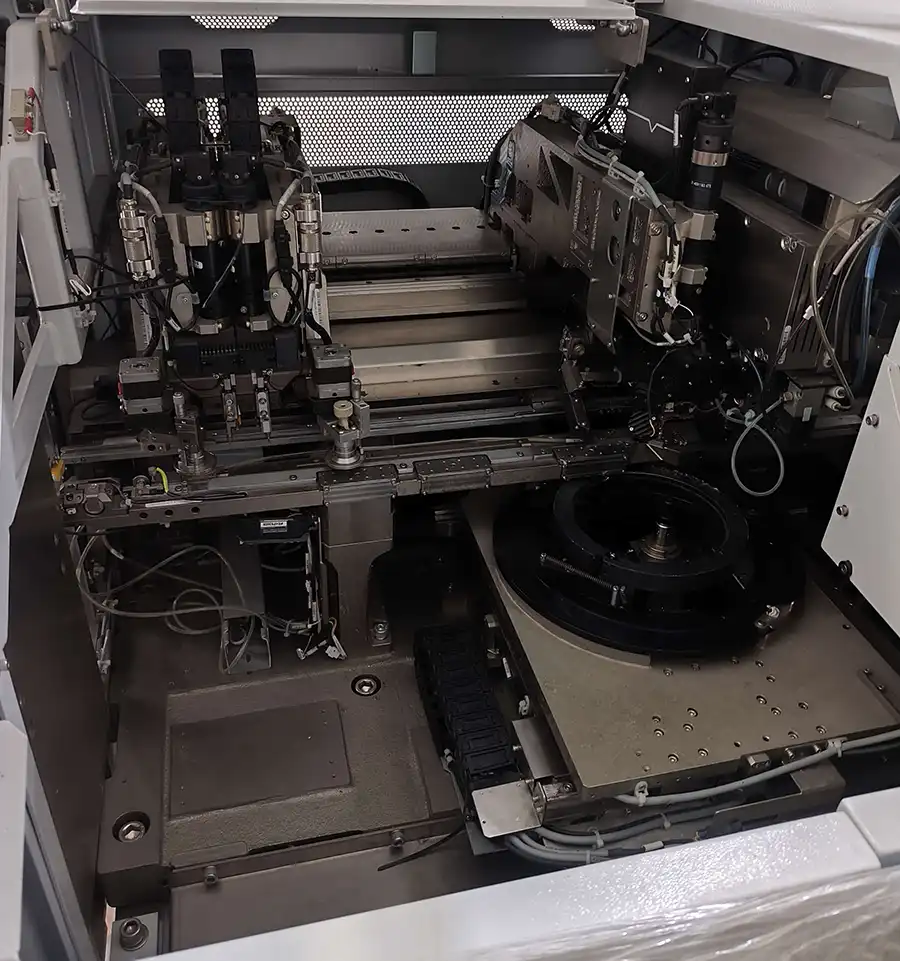
Silver-Epoxy Dispensing or Stamping Configuration
The AD830 Plus may be equipped with silver-epoxy dispensing or stamping modules. These modules are not identical on every machine and should be physically confirmed before purchase.
Dispensing Configuration
A dispensing system uses a syringe and needle to place a programmed quantity of silver epoxy onto the bonding position. Important settings can include dispensing pressure, needle height, delay, dispensing location and deposit sequence.
Stamping Configuration
A stamping system transfers silver epoxy from an epoxy tray to the lead frame through contact with a stamping tool. Correct tool dimensions, epoxy level and stamping height are necessary for consistent material transfer.
Dual Epoxy Stations
Some configurations include left and right epoxy-processing stations. The machine uses motor-controlled stages and programmable process positions for the two sides.
Before order confirmation, check whether the machine includes:
Left epoxy station
Right epoxy station
Dispensing syringe holders
Dispensing needles
Stamping tools
Epoxy trays
Epoxy optics
Pressure-control components
Calibration tools
Required software menus
Vision and Pattern-Recognition Functions
The ASM AD830 Plus uses separate optical functions for wafer alignment, die recognition, lead-frame positioning, epoxy processing and bond inspection.
The documented PR system uses 480 x 480 pixel imaging and programmable LED-array illumination. The machine can store process and vision settings within package files.
Wafer PR
Wafer PR identifies die position and supports automatic die searching. It works with the wafer table to move the selected die to the pickup position.
Work-Holder PR
The work-holder vision system recognizes lead-frame reference features. The detected position can be used to compensate for variations before epoxy application or die placement.
Epoxy Optics
Dedicated optical functions may be installed for the left and right epoxy stations. These functions assist with epoxy-position calibration and process setup.
Pre-Bond Inspection
Pre-bond inspection is performed before die placement. Depending on the recipe, it may be used to check the bonding location, lead-frame reference or epoxy condition.
Post-Bond Inspection
Post-bond inspection checks the result after die placement. It may be configured to identify missing dies, incorrect position, abnormal rotation, epoxy coverage or epoxy bridging.
Image quality, lighting stability, camera focus and recognition repeatability should be tested on a used machine. A visible camera image alone does not confirm that the PR system is accurate or stable.
Lead-Frame Handling Capability
The documented AD830 Plus material-handling range supports lead frames with the following dimensions:
| Lead-Frame Length | 110 to 300 mm |
|---|---|
| Optional Short Length | 80 to 110 mm |
| Lead-Frame Width | 12 to 102 mm |
| Lead-Frame Thickness | 0.12 to 0.76 mm |
| Track Width | 12 to 102 mm |
Compatibility depends on more than the outside dimensions. The lead-frame layout, bond-pad arrangement, indexing pitch, support anvil, window clamp and magazine design must also match the machine setup.
Input and Output Configurations
Different AD830 Plus machines may use different material-loading arrangements.
Magazine Input Elevator
The magazine input elevator receives magazines containing unprocessed lead frames. A pusher transfers the lead frames from the selected magazine slot to the work-holder track.
Lead-Frame Stack Loader
A stack loader picks individual lead frames from a stacked supply and transfers them to the work holder. A special stack loader may be used for certain lead-frame formats.
Multi-Magazine Output Elevator
The output elevator receives completed lead frames and loads them into output magazines. Correct magazine width, height, slot pitch and loading position are necessary for reliable transfer.
Automatic Wafer Loader
Automatic wafer loading and unloading are optional functions. Machines equipped with a wafer loader may also include a wafer magazine, gripper and related setup positions.
Do not assume that an available AD830 Plus includes an automatic wafer loader only because the software contains wafer-related menus. The physical modules must be confirmed.
Standard Functions and Optional Modules
Understanding the difference between standard and optional equipment is important when comparing used ASM AD830 Plus machines.
Documented Standard Functions
Single X-Y-Z linear-motion bond head
Programmable pick and bond force
Airflow-based missing-die detection
Automatic die re-pick capability
Lead-frame position detection
Epoxy-position and bond-position compensation
Automatic wafer-table angular calibration
Dual input lead-frame detection
Multi-magazine output elevator
480 x 480 pixel PR imaging
PR preview and die search
Programmable LED illumination
Possible Optional Modules
Silver-epoxy dispensing assembly
Silver-epoxy stamping assembly
Multi-magazine input elevator
Automatic wafer loading and unloading
Special lead-frame stack loader
Separator-paper detection
Wafer expansion equipment
Wafer mapping
Barcode-reading functions
Machine communication options
SEC I/II interface
Air ionizer
The quotation should clearly state which modules are included, missing, untested or excluded from the equipment supply.
Package Files and Production Setup
The AD830 Plus uses package files to store product and process settings. These files may include lead-frame data, wafer data, material-handling positions, dispensing settings, bonding positions and inspection parameters.
A new product setup may involve:
Copying an existing package file
Entering the lead-frame dimensions
Entering bond-pad layout data
Entering die and wafer dimensions
Adjusting the work-holder track width
Teaching magazine loading and unloading positions
Changing the collet and ejector tooling
Installing the correct anvil and window clamp
Calibrating the wafer and work-holder vision systems
Setting epoxy-process height and position
Teaching pickup and bonding height
Setting pickup and bonding force
Teaching pre-bond inspection
Teaching post-bond inspection
Running test bonds
Completing sample-quality verification
A used machine may contain package files from the previous production process. These files can be useful for machine testing but do not guarantee compatibility with a new product.
Used AD830 Plus Inspection Checklist
Before purchasing a second-hand machine, request an inspection that covers the complete system rather than only the external appearance.
Machine Identification
Machine model
Serial number
Manufacturing year
Electrical rating
Machine configuration
Software version
Mechanical Condition
Bond-head movement
Voice-coil bond-arm movement
Wafer-table movement
Ejector movement
Work-holder transport
Input and output elevator movement
Epoxy-stage movement
Machine covers and safety interlocks
Electrical and Control Condition
Computer startup
Machine software startup
Motion-controller communication
Motor and encoder alarms
Sensor response
Emergency-stop function
Error-history review
Backup availability
Vision-System Condition
Camera image quality
Lens focus
Lighting control
Wafer PR
Lead-frame PR
Epoxy-position calibration
Pre-bond inspection
Post-bond inspection
Production Test
Wafer loading
Die search
Die pickup
Missing-die detection
Epoxy dispensing or stamping
Die placement
Bond inspection
Lead-frame transfer
Output magazine loading
Refurbishment and Service Scope
The service scope for an available ASM AD830 Plus depends on machine condition and customer requirements. A machine may be supplied in used condition, cleaned condition, function-tested condition or after an agreed service procedure.
Possible work may include:
Machine cleaning
Removal of old epoxy residue
Inspection of vacuum tubing
Inspection of pneumatic fittings
Checking collet and ejector assemblies
Checking bond-head cables
Checking sensors and interlocks
Testing work-holder transport
Testing input and output elevators
Checking camera images and lighting
Reviewing recurring alarms
Replacing selected damaged components
Backing up available machine data
Running a functional or sample-production test
Refurbishment should not be assumed unless it is clearly included in the quotation. The completed work and replaced parts should be documented.
AD830 Plus Tooling and Spare Parts
Machine suitability also depends on the availability of tooling and process-specific accessories.
Parts and tools may include:
Collets
Collet bodies and adapters
Ejector pins
Ejector holders
Ejector caps
Dispensing needles
Epoxy nozzles
Stamping tools
Magnetic anvils
Window clamps
Lead-frame magazines
Wafer rings
Vacuum and pneumatic parts
Sensors
Motors and encoders
Cameras and lighting components
Cables and connectors
When requesting a replacement part, provide the old part label, photographs from multiple angles, connector details, installed position, machine serial number and alarm information.
Installation Conditions
| Electrical Supply | 110-240 VAC, single phase |
|---|---|
| Frequency | 50/60 Hz |
| Compressed Air | Minimum 6 bar / 87 PSI |
| Power Consumption | Approximately 1,250 W |
| Recommended Temperature | 10 to 30°C |
| Humidity | Non-condensing operating environment |
The machine nameplate should be checked before connecting the electrical supply. The actual air connections, machine dimensions and required clearance should also be confirmed before factory installation.
Machine Size and Shipping Preparation
The machine dimensions and weight vary according to the installed input configuration.
| Machine Configuration | Approximate Dimensions | Approximate Weight |
|---|---|---|
| With input elevator | 1,700 x 1,240 x 2,080 mm | 1,230 kg |
| With stack loader | 1,560 x 1,240 x 2,080 mm | 1,060 kg |
| With combined elevator | 1,740 x 1,240 x 2,080 mm | 1,240 kg |
Before export packing, moving assemblies should be secured to reduce the risk of transportation damage. Cameras and other sensitive components may require separate protective packing.
Recommended shipping preparation may include:
Removing remaining silver epoxy
Cleaning dispensing needles and epoxy tools
Securing the bond head
Securing the bond arm
Securing the wafer and work-holder stages
Protecting the ejector assembly
Protecting cameras and optics
Disconnecting and securing loose accessories
Using moisture-resistant barrier material
Adding sufficient desiccant
Using a reinforced export wooden case
What Information Should Be Included in Your Inquiry?
To check whether an available AD830 Plus matches your application, please provide:
Required machine model
Preferred manufacturing year
Required machine condition
Die length, width and thickness
Wafer diameter
Wafer-map requirement
Lead-frame drawing and dimensions
Number of bonding positions
Silver-epoxy type
Dispensing or stamping requirement
Required inspection functions
Target production capacity
Required input and output configuration
Tooling requirements
Destination country
Installation or training requirements
Product drawings and representative sample photographs help us review machine compatibility more accurately.
ASM AD830 Plus Supply and Technical Support
We provide independent supply and technical support for used ASM semiconductor equipment. Service availability depends on the machine, project location and requested scope.
Support may include:
Used ASM AD830 Plus machine sourcing
Machine-photo confirmation
Nameplate and serial-number confirmation
Installed-module review
Machine condition inspection
Power-on testing
Functional testing
Sample-production testing
Tooling confirmation
Spare-parts matching
Export packing
International shipping coordination
Installation assistance
Remote technical communication
We are an independent equipment supplier and service provider. Supply and technical services should not be interpreted as official manufacturer authorization unless specifically documented.
Explore additional models and semiconductor bonding systems in our die bonder machine category.
Request a Used ASM AD830 Plus Quotation
Contact us with your required ASM AD830 Plus configuration, production application, die and lead-frame information, destination and preferred machine condition.
We will check the available machine, review the installed options and confirm which inspection, tooling, packing and support services can be included.
Frequently Asked Questions
Is the ASM AD830 Plus a die bonder?
Yes. The AD830 Plus is a fully automatic high-speed die bonding machine designed to pick dies from a wafer and attach them to lead frames using a silver-epoxy process.
Is AD830PLUS the same machine as ASM AD 830 PLUS?
AD830PLUS, ASM AD830 Plus and ASM AD 830 PLUS are commonly used name variations for the same model. Always check the machine nameplate and serial number when confirming equipment or parts.
Do you supply used ASM AD830 Plus machines?
Availability changes according to current inventory. Send your required machine configuration and destination so that available units can be checked.
What is the documented cycle time?
The operating manual specifies a nominal cycle time of 163 milliseconds under defined conditions. Actual production output depends on the package, epoxy process, inspection settings and material-handling configuration.
What die sizes can the AD830 Plus process?
The documented die-size range is 6 x 6 to 200 x 200 mil. Actual compatibility also depends on die thickness, wafer tape, collet, ejector tooling and process requirements.
What wafer size can it handle?
The documented wafer-handling capacity is up to 8 inches. The wafer frame, expander and optional automatic loader must also be compatible with the production material.
Does every AD830 Plus include automatic wafer loading?
No. Automatic wafer loading and unloading are optional. The physical wafer-loader module and related accessories must be confirmed on the available machine.
Does every machine include dispensing and stamping?
No. Silver-epoxy dispensing or stamping assemblies are configuration-dependent. Check the installed modules, tools and software before purchasing.
Can the machine inspect die placement?
The AD830 Plus supports pre-bond and post-bond inspection functions. The actual inspection capability depends on the installed optics, cameras, lighting, software and production recipe.
What should be tested before purchasing a used machine?
The inspection should cover machine startup, axis movement, bond-head operation, wafer table, ejector, vacuum, epoxy modules, vision functions, lead-frame handling, alarms and a representative production cycle.
Can you provide AD830 Plus tooling and spare parts?
Tooling and parts can be checked according to availability. Provide the old part number, photographs, connector details, installed position and machine information for matching.
How is the machine packed for international shipment?
Moving modules should be secured, sensitive optics should be protected and the machine should be packed with moisture-resistant materials, desiccant and a reinforced export wooden case.
How much does a used ASM AD830 Plus cost?
The price depends on the manufacturing year, condition, installed modules, included tooling, testing scope, refurbishment work, packaging and destination. A quotation should be based on a specific machine and documented supply list.
What information do you need for a quotation?
Please provide the die dimensions, wafer size, lead-frame drawing, silver-epoxy process, required machine configuration, target output and destination country.